Showing posts with label Jesus. Show all posts

Tuesday, 3 August 2021

International Left-Handers Day


Image description: a bust photo of Nicholas Ferroni, educator & activist with his quotation…

I was born a sinner too. My sin is mentioned in the Bible 25 times. I tried to change, but couldn’t… Luckily society learned to accept us left-handed people.


Today, 13th August, is International Left-Handers’ Day.


I was born left-handed, a lefty, and was probably part of the last English generation to be forced to be right-handed, at least to write right-handedly. However, prior to disability, I used to be able to scribe with either hand. I use cutlery as a right-hander, but prefer to drink with my left. I played tennis and cricket with my left-hand, but kicked a ball with my right-foot (footedness usually indicates handedness). See this Wikipedia item on Handedness for further details.


Left-handers are often considered to be ‘evil’, ‘sinister’ (the English word is derived from the Latin for left, ‘sinistra’), ‘clumsy’ or less worthy than right-handers. There are many cultural reasons for this.


For several centuries, mainstream Christianity considered those who predominantly used their left-hands to be sinful. Some smaller denominations still do (see for example this by Seventh-Day Adventists). But when was the last time you heard a sermon denouncing left-handedness or sinistrality? The likelihood is probably never if one is young or not since your childhood or youth if one is more mature. In actuality there is not a single Bible verse that categorically states that left-handedness is sinful. The Church as a whole, however, used passages such as Matthew 25:31-34 & 41, to back up their wrongful assertions - a case of blatant eisegesis (placing one’s own suppositions etc. into an interpretation of Scripture)! For background, it may be of interest to note that Judaism does not hold any mores against left-handers (e.g. see this recent article).


Selective ‘Christian fundamentalists’ pick & choose which bits of the Bible they wish to believe in - oddly enough, usually those passages that appear to justify their own bigoted beliefs! Strange how they ignore other parts that are inconvenient, etc.


As a student at university, studying theology away from the biases of specific denominations was a revelation: I discovered just how much official Christianity (whether Evangelical, Anglican, Roman Catholic or Orthodox) has distorted and still distorts Biblical understanding and how it reprioritises and/or suppresses Jesus’ words & teachings.


For some two decades, I was a ‘born-again’ believer. In all the time that folk had prophecies, words of wisdom and pictures, funny how they could pick on sins but never seemed to find the love to support the sinned agin! Also odd was the obsession with sexual sinning, but a total ignoring of inter-personal wrong-doing (such as gossiping, back-biting, bitching, rumour-mongering, etc., and to which we can add the modern sins of trolling and gaslighting) which it can be argued are far more destructive to the individual, community and society as a whole.


The Church - in this sense, all denominations together - is and has long been out to protect itself and its powerful position. Jesus was a radical free-thinker who wanted to completely revolutionise society (e.g. Cleansing of the Temple). He was an early believer in equality - he was, inter alia, proto-feminist (see this article for several examples), anti-classist (e.g. The Widow’s Mite), and anti-racist (e.g. The Good Samaritan). He called for all of us to love everyone: not some wishy-washy emotionalism; but active love-in-action (or agapē). 


Pope Francis has iterated the call for radical love-in-action (e.g. see my blog-post on his Evangelii Gaudium), but the bureaucracy of the clergy ensures that any radicalism is tempered by an ineluctable conservatism.


Change can only occur if the so-called faithful pursue it. Given a couple of millennia of history, I doubt such will come to pass… But one never knows - miracles do happen from time to time, for nowadays the Church no longer considers left-handedness as sinful!


Saturday, 10 July 2021

Political Neutrality is a Lie


Image description: a photo of Holocaust-survivor Elie Wiesel

and a quotation of his:


“Always take sides.

Neutrality helps the oppressor,

never the victim.

Silence encourages the tormentor,

never the tormented.”


There is no such concept as “political neutrality” in actuality. When individuals say to themselves that they are remaining neutral over a given situation, they are in effect lying to themselves and anyone with whom they discuss the matter. Taking a neutral position or ignoring what is going on around you, such as the German people under the NAZIs, is in effect support for that wickedness, as Elie Wiesel attests.


In a democracy, all citizens are responsible for the state of their democracy and the welfare of their fellow citizens. This is solidarity. This is agapē or love-in-action. This is social-justice. Unwillingness to support those who need it, is tantamount to turning your back on your neighbour, cf. Jesu’s words in Luke 10: 25-37:


The Parable of the Good Samaritan


On one occasion an expert in the law stood up to test Jesus. “Teacher,” he asked, “what must I do to inherit eternal life?”

“What is written in the Law?” he replied. “How do you read it?”

He answered, “‘Love the Lord your God with all your heart and with all your soul and with all your strength and with all your mind’; and, ‘Love your neighbour as yourself.’”

“You have answered correctly,” Jesus replied. “Do this and you will live.”

But he wanted to justify himself, so he asked Jesus, “And who is my neighbour?”

In reply Jesus said: “A man was going down from Jerusalem to Jericho, when he was attacked by robbers. They stripped him of his clothes, beat him and went away, leaving him half dead. A priest happened to be going down the same road, and when he saw the man, he passed by on the other side. So too, a Levite, when he came to the place and saw him, passed by on the other side. But a Samaritan, as he traveled, came where the man was; and when he saw him, he took pity on him. He went to him and bandaged his wounds, pouring on oil and wine. Then he put the man on his own donkey, brought him to an inn and took care of him. The next day he took out two denarii and gave them to the innkeeper. ‘Look after him,’ he said, ‘and when I return, I will reimburse you for any extra expense you may have.’

“Which of these three do you think was a neighbour to the man who fell into the hands of robbers?”

The expert in the law replied, “The one who had mercy on him.”

Jesus told him, “Go and do likewise.”


There are not only sins of commission, but also sins of omission. All folk of Faith and all folk of high Morals must work for the good of all, not simply oneself and one’s loved ones, cf. Jesus & the most important commandments, often referred to as the Great or Greatest Commandment. This appears three times in the New Testament, in each of the Synoptic Gospels. I am quoting them in their Biblical order.


The Greatest Commandment


Matthew 22:35-40


One of them, an expert in the law, tested him with this question: “Teacher, which is the greatest commandment in the Law?” Jesus replied: “ ‘Love the Lord your God with all your heart and with all your soul and with all your mind.’ This is the first and greatest commandment. And the second is like it: ‘Love your neighbour as yourself.’ All the Law and the Prophets hang on these two commandments.”


Mark 12:28-31


One of the teachers of the law came and heard them debating. Noticing that Jesus had given them a good answer, he asked him, “Of all the commandments, which is the most important?” “The most important one,” answered Jesus, “is this: ‘Hear, O Israel: The Lord our God, the Lord is one. Love the Lord your God with all your heart and with all your soul and with all your mind and with all your strength.’ The second is this: ‘Love your neighbour as yourself.’ There is no commandment greater than these.”


Luke 10:25-28


On one occasion an expert in the law stood up to test Jesus. “Teacher,” he asked, “what must I do to inherit eternal life?” “What is written in the Law?” he replied. “How do you read it?” He answered, “ ‘Love the Lord your God with all your heart and with all your soul and with all your strength and with all your mind’; and, ‘Love your neighbour as yourself.’” “You have answered correctly,” Jesus replied. “Do this and you will live.”


People of Faith who are sitting on their hands and doing nothing, are not truly faithful… People of Morality who refuse to assist the needy, are not really moral. Both religious and Humanist ethics require of any individual that they:


Do to others as you would have them do to you!


or


Treat others as you would wish to be treated!


This is known as the Golden Rule. If the reader follows the link to the Wikipedia article, one can read its various formations or references in most religions.


*


NB All biblical quotations are from the New International Version aka NIV.


*


Once again, I apologise to readers for the odd appearance of this blog-post. I have tried several different ways to publish and deleted everything twice, but this is how Blogger has decided it is going to be!


Tuesday, 15 June 2021

All Lives Matter to G_d


[Image description: a US American white, male & female couple hold a placard which reads:

Christ & Racism

- DO NOT - mix.

You can’t love God &

Hate His Creation ]


This sign from last year´s Black Lives Matter campaign could equally state:


Christ & Disablism (US Ableism)

- DO NOT - mix.

You can’t love God &

Hate Their Creation.


Sexism, Racism, Homophobia, Ageism, etc. have no place in Christianity. If you believe they do, you are no true Christian. Jesus made it crystal-clear that after loving G_d, the next most important commandment was to love one another. He himself averred that he came to fulfil and thus replace the Old Testament (OT), so there is no justification for quoting scriptures out of context. To be quite clear: There is NO place for hate, treading in the steps of JC!


Black lives matter.

Asian lives matter.

Disabled lives matter.

Wimmin’s lives matter.

LGBTQIA+ lives matter.

Senior citizens’ lives matter.

Poor, working-class men’s lives matter.


If you do not understand why any of the above groupings are suffering in British (or US or Oz) society, then do some research - the internet is full of personal stories, histories from differing perspectives and data for those interested in statistical analyses.

We all have our own prejudices. The path of Faith calls us to to challenge ourselves and learn to stretch out the hand of amity, of friendship to all, not just those who are like us.

*

Peace & blessings! 🙏🏻

*


Saturday, 26 March 2016

Simnel-Cake: a Traditional British Confection for Easter


[Image description: simnel-cake on cake-plate]

In commemoration of my Grandma's funeral, today I am posting my simnel-cake photographs. Each Easter my Gran would make us all a simnel-cake. Last year, due to her death, there was none. So, this year I decided I should follow the tradition she set and I baked a cake for home and a cake to give away. I hope I have done you proud, Gran.

*

I chose a recipe produced by Waitrose (a high-end, UK supermarket) in March 2012. The recipe is © copyrighted, so I am not permitted to reproduce here. However, I doubled the amount of Cointreau and mixed spice, tripled the amount of nutmeg and increased the butter by 20%.


The ingredients (see image above) include:

mixed fruit containing citrus peel
sultanas
Cointreau liqueur
unsalted butter
caster sugar
Chinese stem ginger in syrup
eggs
plain flour
freshly ground nutmeg
ground mixed spice
marzipan
icing-sugar

This is not a cake that can be made in a hurry. The recipe suggests that the fruit is soaked for an hour. I covered and soaked overnight, having carefully stirred the alcohol through several times.

I am arthritic, so creaming butter and sugar is too difficult without my little trick, which traditional bakers will no doubt bemoan: I melt my butter in the microwave before adding the sugar, which part dissolves into the warm liquid. Beware adding eggs too quickly as one does not want them to curdle in the heat. I also added the roughly grated ginger and the sieved flour.

 [Image description: cake mixture]

Having lined my baking-tin, I spooned in half the mixture. Then I added three-eighths of the marzipan which I had rolled into a ball in my palms and then flattened with the heel of my hand (image below).


The resulting 'circle' is then placed atop the mixture (image below).


Then all remaining cake-mixture is spooned into the cake-tin and smoothed (image below).


The cake is then placed into a pre-heated oven (image below) for between 130 and 145 minutes. My oven seems to work a tad faster than that of Waitrose's kitchen.

  
On this occasion I weighed out and so on ingredients for two cakes. Interestingly the first took a good fifteen minutes less to cook thoroughly than the second. When a skewer comes out clean, the cake is done. The cake then has to cool in its tin (image below) prior to being removed.


Once cooled a further three-eighths of the marzipan are used for a circular topping and the remaining two-eighths to make eleven or twelve marzipan eggs.

 [Image description: the decorated cake]

The recipe goes with the former number, but my Grandma went with twelve to represent the eleven loyal disciples and Jesus. Plus, twelve is an easier number to use for slicing the cake!


Then the simnel-cake is ready to be toasted, just long enough to brown the topping and eggs (image above).

By the time I had finished my simnel-cakes, my kitchen smelled divine.

 
The recipe suggests Madeira to accompany. My guests however will be offered the half bottle of Cointreau not used in the cake-making! %P

*

Finally, for anyone wondering what the heck "simnel" means, it comes from an Italian word for semolina, which meant "fine flour".


Sunday, 20 April 2014

A Visit to Santander in Holy Week

Whenever taking the car to Spain, I pass through Santander and have an overnight stay in Hotel Chiqui at the very end of El Sardinero esplanade. On this trip I had two nights in Santander and so had time to explore the city for the first time: it did not disappoint.


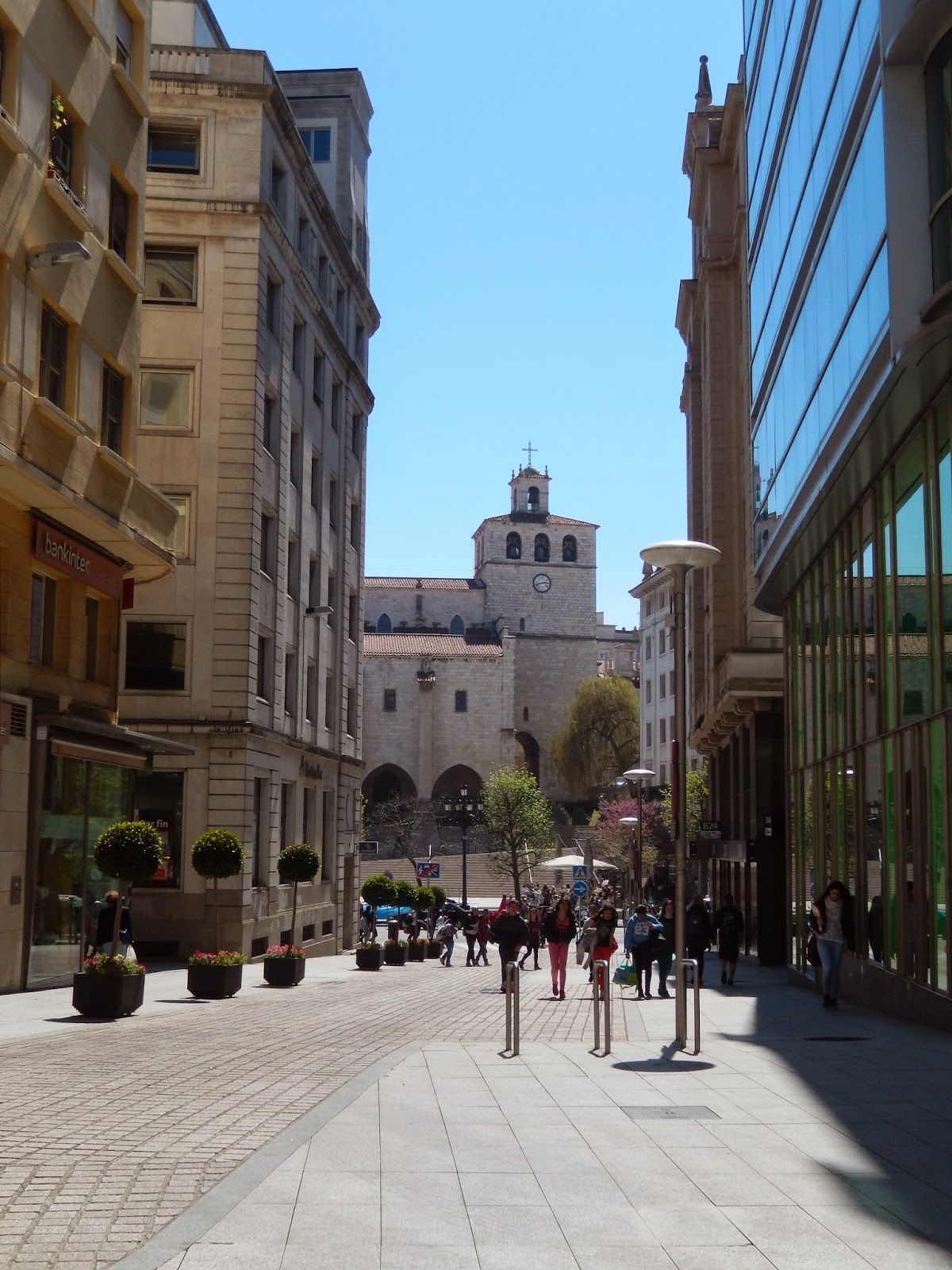
View from Santa Clara towards the Cathedral.


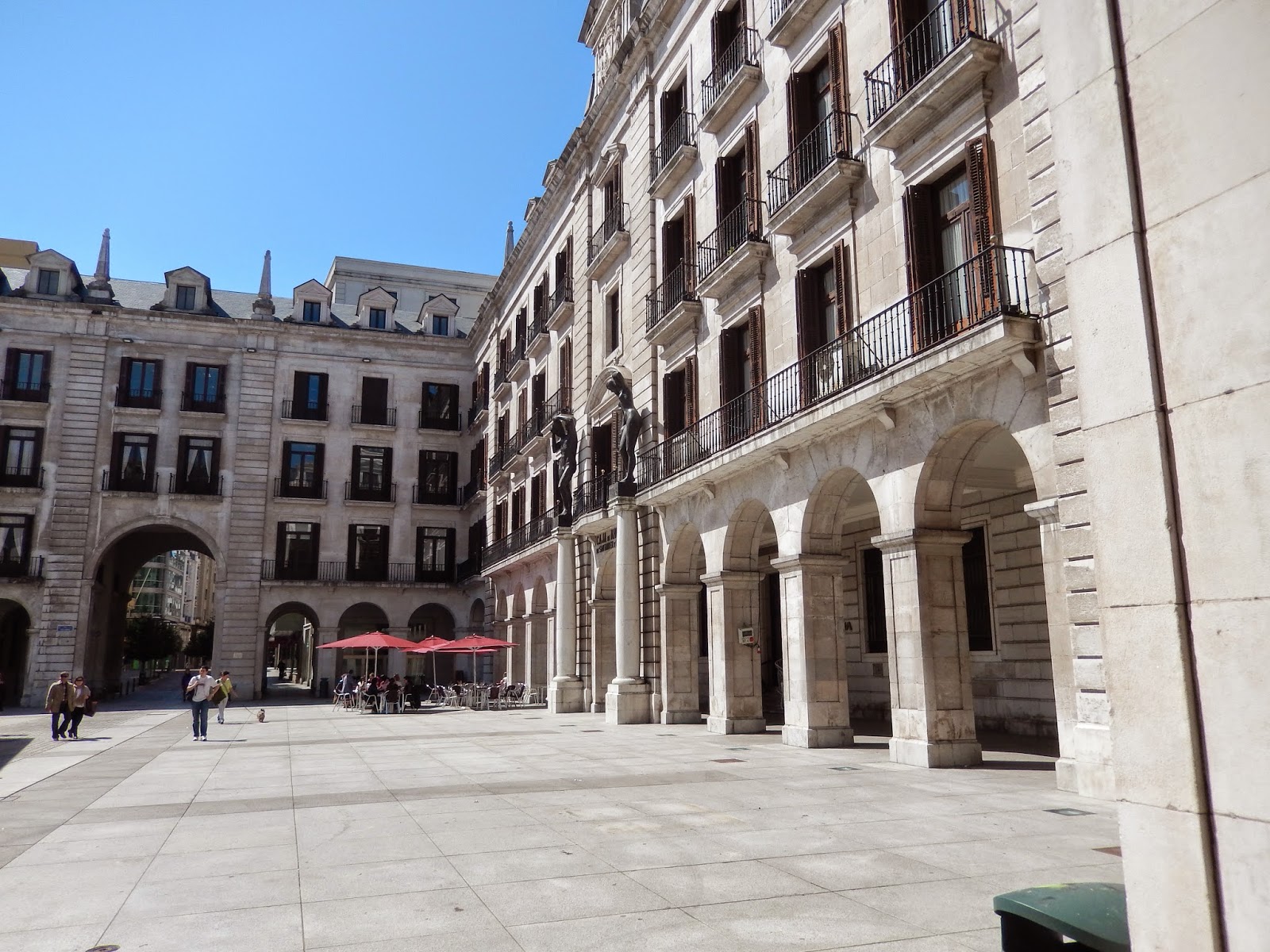
The grand Plaza Porticada (porticoed square) - though avoid coffee at the terrace café as it is terrible and the service poor!


Santander Cathedral or in Spanish, Catedral de Nuestra Señora de la Asunción de Santander.

We were fortunate to arrive during Holy Week, Semana Santa, which saved us touring the churches of the city to view the various ecclesiastical statuary that make up the Stations of the Cross, as they were laid out in a marquee, and we watched as many were decorated with fresh flowers in preparation for being paraded through the streets.


The above images give an overview of the display.


The plaque for El Flagelado, the Scourged Jesus.


Jesus surrounded by iris, symbol of the Virgin Mary, and red carnations, which in Christian iconography, iconolingüística, means love.


The plaque for Nuestra Señora de la Merced, Our Merciful Lady.


The above statue, or imagen, recalls Penélope Cruz to my mind: stunningly beautiful. It just fascinated me, and hence I took a fair few photographs. These four give an impression from afar and then approaching her.


The plaque for Nuestra Señora de los Dolores, Our Lady of Sorrows.


The plaque for El Santo Entierro, the Entombed Jesus.


The effigy of a recumbent Jesus surrounded by statues of the faithful is incredibly realistic, and I personally found the ensemble rather moving. My two companions also enjoyed the experience and the artistry, not just of the sculptors, but also of the embroiderers, the florists and silversmiths.


Wishing all readers
a very happy Easter!
¡Feliz Pascua!


"Él era la luz verdadera
la luz que ilumina a todo hombre,
y llegaba al mundo"

Juan/John 1:9

X


Tuesday, 12 June 2012

Quaker Meeting & Worship

On Sunday I went to church, well Quaker Meeting actually. I have been attending my local Meeting House sporadically for a couple of years now, often with an old collegiate friend. However, I have dipped in and out of various Meetings around Cheshire/Lancashire (NW England) over more than two decades. Due to my ill-health and especially my disabilities, I cannot get to a Meeting by myself and there is not always someone who can transport/take me. However, when I do attend I love it. The meditative communal silence is nothing like personal meditation: there's a vibrancy; a sense of a living entity; a oneness that defies explanation. I suppose one might call it an hour of the numinous (Numinous).

During this week's service part of Quaker Faith & Practice was read out. Below I cite 10.3 from Chapter 10 (Quakerweb), a long quotation which really is worth reading through:


The Religious Society of Friends is organised into local meetings, each of which should be a community. It is our search for God's way that has drawn us together. In our meeting we can each hope to find love, support, challenge, practical help and a sense of belonging. We should bring ourselves as we are, whatever our age, our strength, our weakness; and be able to share friendship and warmth.
Some of us now live away from our families; some of us move house quite often. Although surrounded by others we may be leading isolated and lonely lives. It is important that our meetings welcome newcomers warmly and that we include them in invitations to our homes
Our sense of community does not depend on all professing identical beliefs, for it grows from worshipping together, knowing one another, loving one another, accepting responsibilities, sharing and working together. We will be helped by tried and tested Quaker methods and procedures, but the meeting will only live if we develop a sense of community, which includes children and adults alike. If all those who belong to our meeting are lovingly cared for, the guidance of the spirit will be a reality. The celebration and commemoration of life's great events draw us together as we share the occasion and rejoice or mourn with one another.
Our shared experience of waiting for God's guidance in our meetings for worship and for church affairs, together with careful listening and gentleness of heart, forms the basis on which we can live out a life of love with and for each other and for those outside our community.


The sense of love & oneness, unity if one will, is tangible, despite many folk being strangers to one another. This is an active living embodiment of the sentiment Jesus expressed to John and his disciples and followers. John 13:34-35 states:

"A new commandment I give you: Love one another. As I have loved you, so you must love one another. / By this all men will know that you are my disciples, if you love one another."

Quaker worship differs from many others' religious acts in that what binds us together in worship is not what we believe or do not believe, but what we do. It is an expression of agape (ἀγάπη) or love-in-action. It is the inclusivity that Christ preached, but which is so often lacking in the exclusivist denominations and religions, where one can only belong if one does, says and believes exactly the same as others. We Quakers allow for individuality within communal worship, it adds to each Meeting's distinctiveness. It is a given that we are all at different stages in our spiritual walks. No-one is looked down upon including the atheist, the agnostic or the doubter: for even they have something to contribute to the holistic unity.

During the Meeting I shared a picture of us all playing Ring-a-ring-o'-roses, a game where all hold hands in a circle and which allows for new players to join in simply by the outstretching of hands towards one another. A simple act of welcome and inclusion. At the end of our hour we shake hands with one another much like the sharing of peace in some churches. This is a physical expression of our shared humanity.

I am not saying that Quaker worship is best nor even better than this or that. It suits me, my personality, my individuality; and my ego is added to the collective identity. I am at once an individual and a part of a community, a member of a body of worshippers.

Quakers do not sing together - at least I have never experienced such. However, during last Sunday's get-together the words of an old song (©Kingsway) from the seventies came to mind:

"Bind us together Lord;
bind us together,
with cords that cannot be broken.
Bind us together Lord;
bind us together;
bind us together with Love."