Disability Rights UK are running aseries of meetings around the countries to obtain feed-back from people with disabilities and their carers about the issues that concern us in order to feed into the United Nations's review of the application here of UNCRPD (which we ratified in June 2009).
Naturally many if not most of us cannot attend these sessions, so DRUK (logo below) have set up a two page survey: the first page is contact details; the second the issues each of us considers to be important. The answers here can be as short or as long as you require.
I have detailed my responses below, as this might prompt your own responses.
*
What
are the priority issues that you believe should be included in our
report to the UN Committee on the Rights of Persons with Disabilities?
i) financial support issues, especially removal of benefits from those with disabilities; ii) accessibility issues (transport, buildings, websites, new products); iii) onerous re-assessments (WCA/ESA/PIP) for those who are not going to ameliorate (based on dogma, not efficiency savings); iv) excessive bureaucracy - need one system that can be used by NHS, social services & DWP; v) countering anti-disability rhetoric & polemic - law to prevent MSM & politicos from inciting hatred; law to ensure balance of views on MSM, so that free speech is protected but not to the detriment of disabled & other minority groupings; jurisprudence system must take issues seriously & rigourously use appropriate laws for prosecustions & sentencing; vi) independent ODI at arms-length from Govt., but given appropriate powers and funding to investigate disability issues both for the individuals concerned & whole of society; vii) separation of disability issues from EHRC and re-establishment of a truly independent DRC (if indy ODI not poss), as the former has failed (as predicted) to rigorously pursue disability issues, but given appropriate powers and funding to investigate disability issues both for the individuals concerned & whole of society.
Only since approximately 2010 have I felt fearful of my own government & fellow countrymen. I used to regularly go out & about in my mobility-scooter, but after the co-alition govt. took power the politicos & MSM launched frequent attacks against disabled folk, with much press being given to "scroungers" and defrauders. I stopped going out in my scooter and sold it last year, as I received abuse every time I went out, from students at the local college and from traffic passing me on the main road. I am now on anti-anxiety medication. Strangers now (contrary to previous British reservedness) approach one and believe it their right to question one about one's condition, disabilities and right to receive social security payments.
Evidence: i) Plenty of examples of hardship and even death due to DWP's sanctions régime have appeared in press, websites and via activist groups. ii) The DDA was introduced in 1995, but still inaccessible buildings, road-crossings, & other structures are built. Local Authorities ought to be obliged to factor in access issues at the planning-approval stage, rather than the onus being on disabled folk to sue once a structure has been constructed. iii) I have severe ME as defined by NICE and my NHS consultant. There is NO scientific evidence that folk in said category ameliorate. Yet DWP still re-assesses periodically. This is detrimental to my & many others' health, as stress pejorates our illness. The assessment régime is thus making us worse. This also wastes public money. There is already a clause that every benefit-recipient has to sign confirming that we will notify DWP of any amelioration/pejoration. A sytem based on trust would be much more cost-effective. Therefore one has to conclude that the system is deliberately antagonistic for dogmatic reasons. iv) Forms have to be completed for every single agency, much of the information requested is the same. So the booklets (c. 40 pages so not mere forms) for ESA and PIP have much overlap; as do the ones for social services; then the care agencies want the same info again. I imagine that much of this info would also be useful for the NHS - reducing bed-blocking, ensuring continuity of care, etc. v) There was some research done into bias in MSM - sure you know of it. However some mainstream TV channels still produce voyeuristic programming into the lives of folk dependent on social security. There has been some evidence that the CPS and the courts are failing to use current laws, although the former recently announced an increase in the past year of prosecutions. Judges appear unwilling to use the law that permits extra sentencing where a disability hate aspect occurred. vi) The ODI is a vassal of the DWP. I have covered on my own blog the annual failure of this department to support UN Enable's "International Day of Persons with Disabilities" and the pertinent issues raised each year (http://crippledqueeranglo-europeanranter.blogspot.co.uk/2015/12/international-day-of-persons-with.html ; http://crippledqueeranglo-europeanranter.blogspot.co.uk/2014/12/international-day-of-persons-with.html ; http://crippledqueeranglo-europeanranter.blogspot.co.uk/2013/12/international-day-of-persons-with.html). vii) The EHRC published a list of questions it wanted answered by the Govt. in 2014, nearly five-and-a-half years after UNCRPD was ratified by UK - in the meantime disabled folk were starving, commiting suicide and dying due to UK govt. policies (http://crippledqueeranglo-europeanranter.blogspot.co.uk/2014/12/monitoring-uncrpd-in-uk.html). I feel certain a dedicated DRC would have acted much faster seeing the toll of suffering my fellow disablies were experiencing.
*
Please do respond if you are able, as the more of us that do so, the better DRUK's response to the UN. Cheers!
I have been so ill this year and particularly bad this past couple of months that I have missed so much. Fate must have been conspiring behind my back, for this morning I awoke refreshed from ten hours of uninterrupted slumber (did not even hear the alarm which was supposed to remind me to turn in bed to prevent bed-sores) with energy and to the most glorious wintry morning. I even went downstairs this morning to greet lovely carer #2 to her pleasant surprise. I actually have a smile on my face. Hang on need another coffee from the Senseo® machine… These drink-making machines are great, creating one cup of a delicious and warming hot beverage whenever I need. Due to inter alia my arthritis and being bed-ridden, I used to have to go without hot drinks for the most part unless someone visited.
Right, back… [slurp] Mmmmmmmm - lovely!
So, to the point in hand: today is International Day of Persons with Disabilities (on Twitter one of today's main hashtags is #IDPD2014). Per UN Enable (screen-shot above) this year's theme is "Sustainable Development: The Promise of Technology". Well, however important that may be from a global, even individual perspective, it certainly is not inspiring me and I do not have the energy, resolve nor cognitive ability to delve into the subject to research it and write a blog-post today.
Instead, I have decided to update on my previous contributions and share just some of the disability issues that have come to my attention over the past couple of days via wifi to my laptop.
and the failure of many charities to step up to the plate!
At the time of writing, no response from DRUK. It's amazing isn't it: just how quickly organisations can fail to respond. What did we do before social media?
DRUK have issued a reasonably balanced, between highlights and low-lights, overview statement on the state of disabled folks' rights in the UK. The following is particularly galling given that the United Kingdom is a full signatory to UNCRPD:
More disabled people are going into institutions than coming out, despite government promises; and the number of people being forcibly treated or detained against their will has gone up year on year. These are major human rights abuses.
In 2013, I pointed the finger at the Office for Disability Issues (ODI) a subsidiary of the much-detested and infamous Department of Work & Pensions (DWP). Interestingly the ODI no longer has a separate website but has been subsumed into a page on gov.uk. Yet again, today is totally ignored; the most up-to-date article is from 4th September 2014 (see screen-shot below).
What does that say about how valued disabled folk are in the United Kingdom? What does it say about the UK ConDem co-alition's attitude towards both us and the United Nations?
Hang on! Pill box is just reminding me I need to take some medication…
As many readers will know, one of my debilitating conditions is myalgic encephalomyelitis (ICD-10 G93.3 - thank the maker for Wikipedia!).
I felt like this morning was Christmas Day as M.E. aka C.F.S. rarely gets such coverage. As the spokesperson from the M.E.Association says:
There are no psychological quick fixes for serious, classic ME, but there is mounting evidence that it is caused by a barrage of neurological, immunological and endocrinological assaults on the body.
And incidentally, whilst I have been writing this article, I have just had an email from my G.P. discussing my health-care, what actions we might take and she also arranged for a prescription to be sent through to my pharmacist, who will deliver my meds later. Before e-health I could wait days to hear back from the medical practice replying to slow-mail (aka letters) and then I would have to wait even longer for my prescription drugs to be collected.
Oh, also just now had an email from the agency which supplies my carers discussing arrangements for the rest of the week. Both they and I now have more flexibility in if-when-and-how matters as they can be quickly resolved.
And finally, a couple of matters on transport - in its broadest sense. I received an email (see screen-shot below) this morning from the Papworth Trust asking me to complete a survey on train-travel.
I was more than happy to do so, as I have had some awful experiences. However, I must express my gratitude by stating that the support team at Euston Station in London have always been absolutely fantastic - never once a problem - which is more than can be said for support at Piccadilly Station in Manchester, I am ashamed to reveal.
If you have a spare five minutes, please consider completing the survey. Cheers! %)
Transport for All, is based in London. I am not. However, I believe that what London gets will eventually be shared with the rest of the country. A week or so ago, a friend in Spain made me aware of a video of an invention that could improve the lives of disabled folk, parents with push-chairs, travellers with luggage and so on: an adaptation to escalators.
I shared this with TfA, and they are as excited about it as I am and so have shared it themselves. Thus spreading the word and apprising many more folk of this wonderful idea. Well, that's it for my review of disability issues which entered my æther in the past twenty-four hours. Who would want to discuss the oh-so-dull topic of technology? ;)
This is a revised version of the blog I published a week too early due to my dyscognition!
Today is International Day of Persons with Disabilities, 3 December 2013. The theme for this year is “Break Barriers, Open Doors: for an inclusive society and development for all”
"It’s time to effectively implement the Outcome Document of the High Level Meeting and to break barriers and open doors: to realize an inclusive society and development for all!
The commemoration of this year’s International Day of Persons with Disabilities provides an opportunity to further raise awareness of disability and accessibility as a cross cutting development issue and further the global efforts to promote accessibility, remove all types of barriers, and to realize the full and equal participation of persons with disabilities in society and shape the future of development for all!"
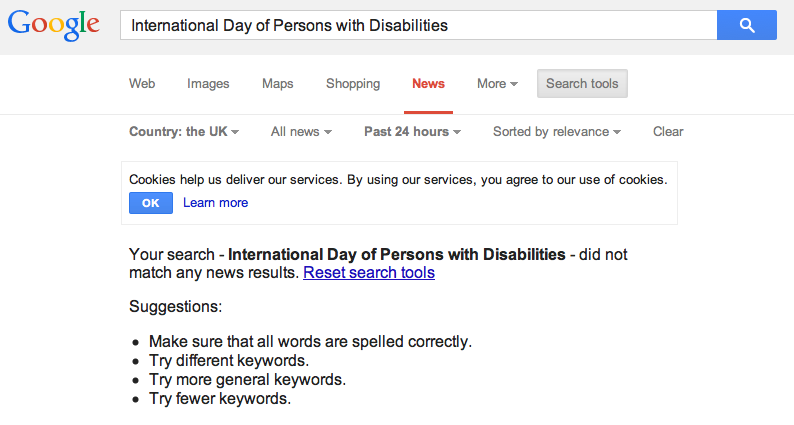
One might have thought that this would be an important and newsworthy event. Well if Google is anything to go by, it looks as if there has not been a single UK main-stream media news story about it in the last twenty-four hours. Though stories have appeared in inter alia Kuwait, Oman, India and New Zealand.
I have also ploughed through my feedly newsfeed for the past twenty-four hours. Not a hoot from the BBC nor ITN.
So maybe one might expect the UK Government's department, the Office for Disability Issues (ODI) [which incidently is run within the notorious DWP] specifically set up to look out for disabled people's interests to cover the day, even if it does not wish to celebrate disabled folk. Well, I first of all checked out their news page - [as at 10.42] it has not been updated since July 2013 - see the screen-shot below.
However, to give the ODI their due, I did find a link on their home-page. It reads:
21st International Day of Disabled People – 3 December 2013Every year the International Day of Disabled People is used to promote an understanding of disabled people and encourage support for their dignity, rights and well-being.The United Nations chooses a different theme for the Day and in 2013 it’s going to be: ‘Break barriers and open doors: to realise an inclusive society for all”.We know that the barriers that disabled people face can take a variety of forms. They might relate to the physical environment or to information and communications technology (ICT) which are not accessible. They could result from legislation or policy. Or they might be the result of attitudes in society, or discrimination.The International Day is a great opportunity to celebrate the achievements of disabled people and their contribution to society. This year’s theme offers the opportunity to highlight barriers, and how they have been successfully challenged and overcome. This year on 3 December, ODI will be publishing the second edition of Aspire 2, the online magazine which aims to inspire young disabled people to get involved with disability issues. The magazine’s theme will be Attitudes and it will include articles by the Minister of State for Disabled People, Mike Penning; Channel 4 presenter Alex Brooker; and Paralympian Louise Hunt.Find more information about the International Day including how the United Nations encourages it to be commemorated, and the themes adopted in previous years.We are encouraging disabled people and their organisations to celebrate the Day. We want to help share information about what is going on, and think how we can collectively make an even bigger splash next year.So if you are planning an event, you can let us know by emailing ODI at:fulfilling.potential@dwp.gsi.gov.ukPlease head your email: International Day of Disabled People.
Interestingly, despite the glib spin, the ODI does not acknowledge its part nor it's parent department's huge influence in actually creating barriers to independent living. Nor do they confess to starving the disabled of funds to pay for the essentials of quotidian life: vital food, heating, medications, transport, education and jobs, due to the incompetence, negligence and in some cases deliberate actions inspired by their harmful ideological policies.
In the UK two hashtags are being used on Twitter. As far as I can tell the main ones are #IDPD and #IDPwD, but some are using #IDPD2013. The latter has a more international flavour.
I have been connected with the WoW Campaign for more than a year now. We are fighting for rights and in many cases the right to live. The WoWpetition has just nine days before it expires. It has already garned the 100,000 signatures needed to ensure the petition is considered for debate in the House of Commons (the elected part of the UK Parliament).
If you are a UK citizen resident at home or abroad, you are entitled to add your electronic monicker here:
Edited at 14.00: Note I suffer from dyscognition and memory problems; I am a week ahead of myself; no wonder there's no news!!!! Today is International Day of Persons with Disabilities, 3 December 2013. The theme for this year is “Break Barriers, Open Doors: for an inclusive society and development for all”
"It’s time to effectively implement the Outcome Document of the High Level Meeting and to break barriers and open doors: to realize an inclusive society and development for all!
The commemoration of this year’s International Day of Persons with Disabilities provides an opportunity to further raise awareness of disability and accessibility as a cross cutting development issue and further the global efforts to promote accessibility, remove all types of barriers, and to realize the full and equal participation of persons with disabilities in society and shape the future of development for all!"
One might have thought that this would be an important and newsworthy event. Well if Google is anything to go by, it looks as if there has not been a single UK news story about it in the last twenty-four hours (see the screen-shot below for confirmation).
So maybe one might expect the UK Government's department, the Office for Disability Issues (ODI) [which incidently is run within the notorious DWP] specifically set up to look out for disabled people's interests to cover the day, even if it does not wish to celebrate disabled folk. Well, I first of all checked out their news page - it has not been updated since July 2013 - see the screen-shot below.
However, to give the ODI their due, I did find a link on their home-page. It reads:
21st International Day of Disabled People – 3 December 2013Every year the International Day of Disabled People is used to promote an understanding of disabled people and encourage support for their dignity, rights and well-being.The United Nations chooses a different theme for the Day and in 2013 it’s going to be: ‘Break barriers and open doors: to realise an inclusive society for all”.We know that the barriers that disabled people face can take a variety of forms. They might relate to the physical environment or to information and communications technology (ICT) which are not accessible. They could result from legislation or policy. Or they might be the result of attitudes in society, or discrimination.The International Day is a great opportunity to celebrate the achievements of disabled people and their contribution to society. This year’s theme offers the opportunity to highlight barriers, and how they have been successfully challenged and overcome. This year on 3 December, ODI will be publishing the second edition of Aspire 2, the online magazine which aims to inspire young disabled people to get involved with disability issues. The magazine’s theme will be Attitudes and it will include articles by the Minister of State for Disabled People, Mike Penning; Channel 4 presenter Alex Brooker; and Paralympian Louise Hunt.Find more information about the International Day including how the United Nations encourages it to be commemorated, and the themes adopted in previous years.We are encouraging disabled people and their organisations to celebrate the Day. We want to help share information about what is going on, and think how we can collectively make an even bigger splash next year.So if you are planning an event, you can let us know by emailing ODI at:fulfilling.potential@dwp.gsi.gov.ukPlease head your email: International Day of Disabled People.
Interestingly, despite the glib spin, the ODI does not acknowledge its part nor it's parent department's huge influence in actually creating barriers to independent living. Nor do they confess to starving the disabled of funds to pay for the essentials of quotidian life: vital food, heating, medications, transport, education and jobs, due to the incompetence, negligence and in some cases deliberate actions inspired by their harmful ideological policies.
I have been connected with the WoW Campaign for more than a year now. The WoWpetition has just nine days left to garner the remaining 6,000 or so signatures needed to attain the 100K that will ensure the petition is considered for debate in the House of Commons (the elected part of the UK Parliament).
If you are a UK citizen resident at home or abroad, you are entitled to add your electronic monicker here:
Monday 3rd December is International Day for Persons with Disabilities. According to United Nations Enable:
How the Day may be observed
Based on the main theme of IDPD 2012 “Removing barriers to create an inclusive and
accessible society for all”, sub-themes can be selected to cover all aspects of society and development, including, but not limited to, removing barriers to education, employment, transportation, travel and tourism or sports. You can select a sub-theme to address a specific issue of exclusion and accessibility in your community.
Include: Observance of the Day provides opportunities for participation by all stakeholders – Governments, the UN system, civil society and organizations of persons with disabilities – to focus on issues related to the removal of barriers to create an inclusive and accessible society that would benefit all.
Organize: Hold forums, public discussions and information campaigns in support of the themes of IDPD 2012 to find innovative ways and means by which barriers to the inclusion of persons with disabilities and their families can be broken down.
Celebrate: Plan and organize performances everywhere to showcase - and celebrate - the contributions made by persons with disabilities as agents of change and development in the communities in which they live.
Take Action: A major focus of the Day is practical action that would help to remove barriers that limit accessibility for and participation by persons with disabilities in all aspects of society and development. Highlight progress and obstacles in creating accessible and inclusive society, including in terms of physical environments, information and communications technology and other areas, as well as promote public awareness of existing barriers to the full inclusion of persons with disabilities in their societies.
A blog article will appear here on Monday entitled, "Who represents disabled folk?" I hope you will come back to read it. %)