Showing posts with label Bed-Bound. Show all posts

Wednesday, 2 June 2021

What Does Housebound Mean?


For several months I have been attempting to determine from my G.P. (family-doctor) whether they recommend me having the Covid19-vaccination (taking into account my various health-issues), which type to have if vaccination is clinically appropriate and also to arrange for the jab to be given at home, due to my being mostly bed-bound or bedridden as well as mostly house-bound.


I received a reply, after several reminders over these past months, last week. The practice-manager wrote:


“I have reviewed you medical record and given that you are able to travel abroad for the winter this technically does not make you housebound.” (sic)


The reader may consider that the practice-manager’s perspective is valid. However, there is no legal definition of what constitutes being house-bound (ditto in re “bedridden” or “bed-bound”). Thus, there can be no technical breach of a non-existent definition.


I have replied to the message I received and below is the pertinent section.


*


Now to the the very thorny issue of what constitutes being “housebound”. As you are no doubt aware, there is no English legal definition. However, there appears to be a working NHS definition (alas I could not track down), upon which the following seem to be based:


“An individual will not be eligible for a home visit if they are able to leave their home environment on their own or with minimal assistance to visit public or social recreational public services (including shopping)” [source]


“A Housebound patient is defined as being an individual who is unable to leave their home environment due to a physical or psychological illness. An individual is not housebound if they are able to leave their home with minimal assistance to visit, for example, Neighbours, Hairdresser, Supermarket, Bingo.” [source]


“A patient is considered housebound if… The patient cannot leave home without considerable and taxing effort.” [source]


I have thus far this year only left my home on three occasions, each time with carer-support: on 12th February for a 3 minute visit a mile away (via car) to my ex-boyfriend who has cancer and who has been in a bubble of one during lock-down periods (equipment: walking-sticks & portable stool) - it took approximately two days for me to recover from the exertion; (via car) to vote in May (equipment: wheelchair) - again, it took approximately two days for me to recover from the exertion; (on foot) to visit my next-door-but-one neighbours for a socially-distanced cold meal on 22nd May (equipment: walking-sticks) - it took approximately five days for me to recover from the exertion. None of these were appointments, as I am currently unable to specify an exact time when I can do anything due to the precarious state of my health. You will note I have not left my home even once per month. In fact, I have managed to leave my bed-cell (bedroom) less than once per week this year. And that is also the same sort of statistic for last year as well.


I am NOT able to leave my home without taking into account:


* carer support - to prevent accident incl. falls (inter alia dyspraxia, BP), to support when narcoleptic ([hospital specialist/consultant]’s term) and general assistance, incl. financial know-how (inter alia dyscalculia, dyslexia);


* wheelchair or walking-sticks [US canes] (e.g. to neighbours) depending on distance;


* pain medication prior to, during and after any journey, time/distance/purpose dependent;


* incontinence-pads, depending on distance/destination/purpose - if I am likely to become anxious, then the pads are needed;


* water-bottle for car-travel as I require frequent urination when nervous, and travel generally makes me anxious;


* rest - I save up energy prior to journeys and rest afterwards to ensure I try to remain within my energy-envelope.


* sunglasses - to prevent photophobic pain.


* ear-plugs/head-phones - to prevent pain due to hyperacusis.


Under no reasonable understanding can my personal situation be deemed to be outside the remit of needing more than “minimal assistance”. When travelling abroad I take one or two carers, depending on need, as I have to be pushed in my wheelchair (partly due to the chair being unsuitable for self-propulsion) and assisted to do almost everything. Remember, here in the UK, I have carers to ensure I eat, take medications, drink and to help with personal hygiene & dressing. I am wheelchair-ed throughout the æroport. I need assistance to use the æroport toilets. I am assisted on to aircraft either manhandled or via Ambulift, depending on the æroport’s facilities. Again this is not “minimal assistance”.


Additionally for the past couple of years or so I have been bedridden [aka bed-bound] just over 95% of the time, up from my previous 85% proneness.


My en suite w.c. is 3 metres from my bed. It typically takes me upwards of 8 seconds to reach it, depending whether I walk (shuffle) or quite literally crawl. The latter I only need to do when defecation becomes necessary (IBS, diarrhœa), as I have a water-bottle for urination.


Additionally, due to my frequent falls, when out of bed and when alone in the house I wear a pendant-alarm so I can call for assistance. Frequent falling is a sign of frailty.


I also have severe difficulties in mounting or descending stairs, so generally go down on my bottom and crawl up on hands and knees. The inability to use stairs is indicative of frailty.


It is my understanding that my gait speed would also indicate frailty. Indeed, using the Edmonton Frail Scale, I come out as having mild to moderate frailty, depending on the time of year/my state of health. And bear in mind, I am not yet even considered agèd!


Furthermore, were I to be taken in an ambulance to Addenbookes or a London hospital, it would take much longer than the journey to Spain, for example. Being able to leave one’s home with assistance does not lead to the conclusion one is not house-bound, but rather the opposite, that one is house-bound without assistance.


So, to sum, I am de facto both housebound and bedridden the vast majority of the time.


Your definition and understanding appears to be lacking in understanding of my personal situation (odd given you are aware that some years I travel to Spain under the advice of both my G.P.s and hospital consultants!) and everyman’s reasonable definitions of the terms “housebound” and “bedridden”.


In the circumstances, I must insist that you develop a thoroughly thought-through policy with clear definitions of what [the medical-practice] considers “housebound” and “bedridden”. It is then imperative that [the medical-practice] goes through its patient-records and appropriately corrects them as well as taking any pro-active actions to remedy any failures to support patients.


[Image description: the writer in his bed-cell]


Wednesday, 12 May 2021

International M.E. Awareness Day 2021


Today, 12th May (US May 12th) is International M.E. Awareness Day. In some countries Myalgic Encephalomyelitis (M.E.) is misnamed Chronic Fatigue Syndrome (C.F.S.).


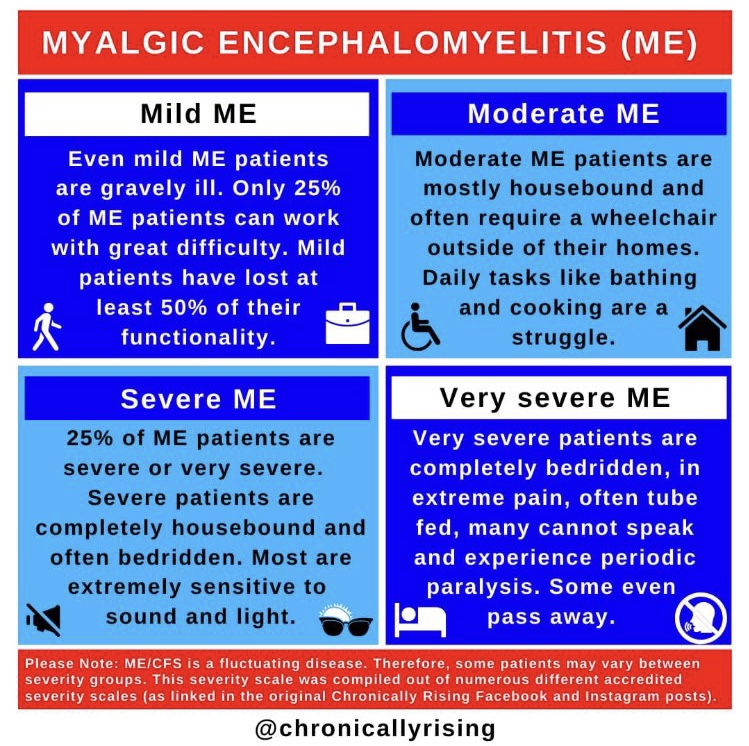
There are three categories of suffering per N.I.C.E.: mild - a loss of 50% of function (what other condition is described as “mild” with a loss of half one’s previous abilities!), but many can still work (G-d knows how!); moderate - mostly house-bound and unable to work; severe - mostly bed-bound. However, the M.E. community is well aware of a fourth category, “very severe”, in which sufferers are mostly blindfolded, earplugged & drip-fed, unable to do anything, not even move (often paralysed), but exist and suffer. Individuals quite literally die from M.E. [The image below is an M.E. taxonomy based on several international criteria - apologies to the sight-impaired, there is far too much text for me to type up.]


I was diagnosed with M.E in 1998. Prior to that I had been diagnosed as having Post-Viral Fatigue Syndrome. Both conditions are classified by the W.H.O. in ICD-10 at G93.3, as neurological conditions (and have been since 1969). Even so, in the U.K., Denmark & the Netherlands especially, where a psychiatric cabal control much of the medical establishment, and in the U.S. until relatively recently, the disease has been treated as a mental-health condition, in contradiction to all the scientific evidence which demonstrates inter alia differences in sufferers’ brains, spinal-columns, hearts, blood-flow, blood-work, biomes, etc.


Recently I have begun to suspect my condition probably commenced at puberty, if not beforehand. Under the current N.I.C.E. guidelines (which are about to be updated) I have been and am classified by my G.P. (family-doctor) and by my N.H.S. hospital-consultant as suffering the severe form. Mostly I am bed-bound, nigh on all the time house-bound. However, with one or two assistants, I am able to travel with lots of planning. This would put me in the moderate grouping. Similarly, there are times when I suffer temporary paralysis, which places me within the very severe grouping. M.E. Is an unpredictable disease that constantly fluctuates. Prior to Severe M.E. Day in August I hope to have conducted some research into my medical history, to attempt to determine the approximate start of my condition, assuming it is not congenital. As long as all goes well, I hope to publish a blog-post on 8th August (August 8th).


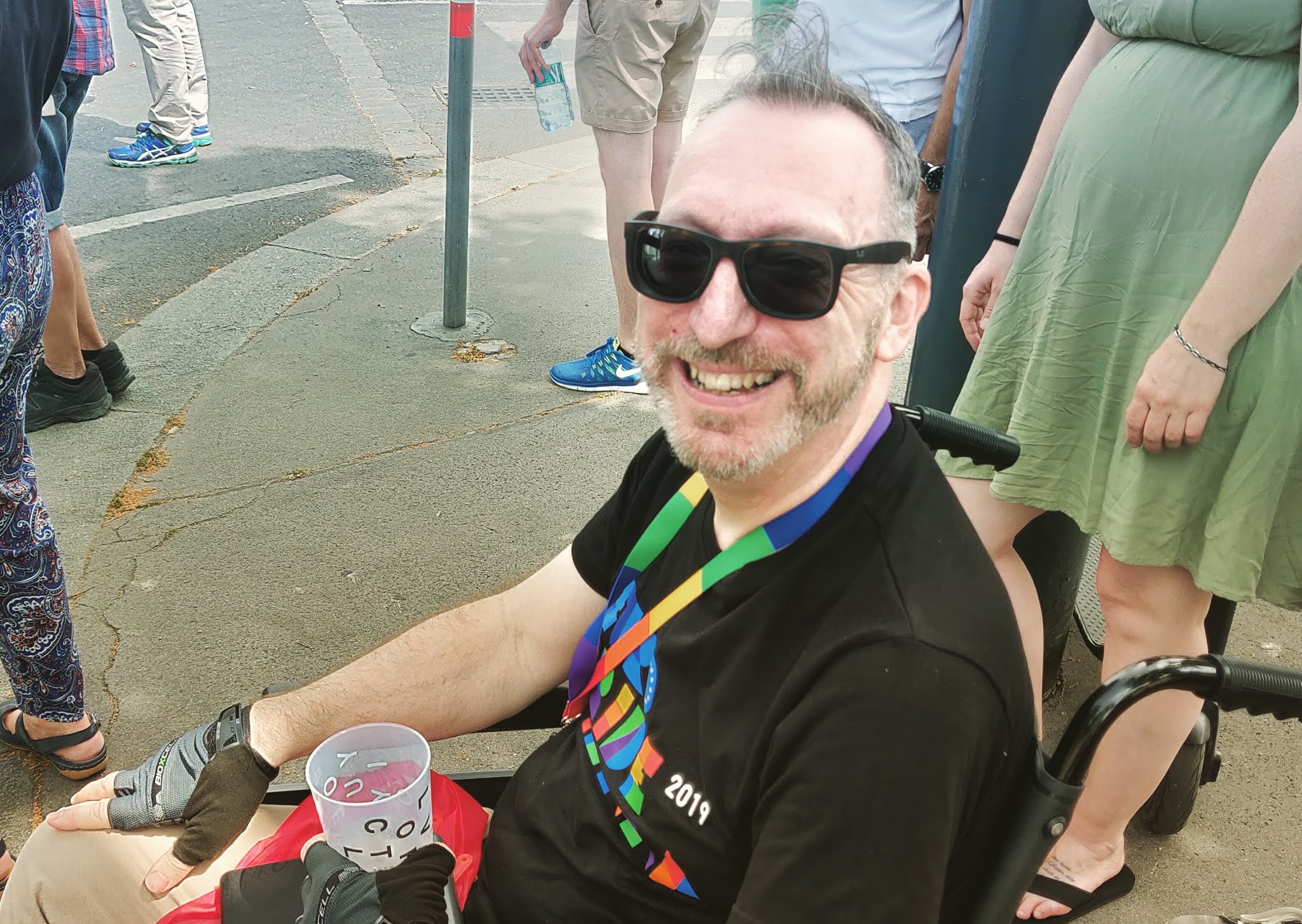
[Image Description: the writer in sunglasses and wheelchair enjoying a day out.]


However, for the purposes of my argument today, I am looking at the time-frame 1998-2021. Whilst the numbers of suffers of M.E. is in the tens of millions worldwide, and currently estimated - excluding the new-comers via Covid-19 so-called Long-Covid - to be circa 250,000 - 500,000 in the U.K. That is roughly 1:200 folk having some form of the disease. Every G.P.’s list is estimated to have around forty sufferers. And yet the vast majority of family-doctors know little or nothing about the disease apart from the myths and prejudices, which they (mostly) also perpetuate.


There is NO TREATMENT for M.E.  More than half-a-century has passed since the W.H.O. classified this disease. Until the 21st century very little medical-research was carried out. Even now, most research is funded by sufferers as governments have all but turned a blind-eye to both the disease and especially those who suffer from it. The Pharmaceutical industries have also done very little research (as far as is known), reluctant to invest monies when so little is known about the disease. However, in the past few years the Norwegian Prime Minister apologised to her citizens for their mistreatment by Norway’s health-services. Researchers, especially in the U.S., Australia, the Scandic countries and even the U.K. have been gradually uncovering the secrets of the illness and finding or developing treatments that may help sufferers. Whilst these are still the early-days for same, there is at least some hope.


*


If the reader knows a person with M.E. (PwME) within their family, friend-group, or community, please do consider volunteering some of your time &/or money to an M.E. Charity.


*


Apologies for the changes in text-size and alignment - this is not down to me, the writer, but due to issues with Blogger.


Tuesday, 12 May 2020

International M.E. Awareness Day 2020


I have not been well enough at this time of the year since 2017, so this is my first blog-post to mark the international Myalgic Encephalomyelitis awareness day in three years. (Underneath this blog-post is a list of words and terms, click on any of the ones referring to M.E. to find some of my previous outpourings.)

Under the UK’s current N.I.C.E. Guidelines and by my NHS hospital specialist, I am classified as having the severe form of M.E. There are three official categories: mild, moderate, & severe. However, the severe category itself covers a range of folk from those who are mostly bed-bound, like myself, to those who cannot ingest food or water and have to be kept alive via feeds.

In my previous blog-post I wrote:

“M.E. is not about being tired all the time. It is not a psychiatric illness as the UK’s psycho-cabal (along with their colleagues in Holland & Denmark) would have us believe. It is a multi-systemic, neurological disease (recognised for decades as such by the WHO, currently under ICD-10 G93.3). There are 106 conditions on my health spreadsheet; 104 are connected with Myalgic Encephalomyelitis. Only three are related to sleep. Under the WHO’s ICD-10 I have conditions under sections I, IV, V, VI, VII, VIII, IX, X, XI, XII, XIII, XVIII & XIX.”

I have mulled over the possible threat to my privacy and so forth, but have decided to publish the full list of my conditions. Obviously I have had to hide certain personal details to prevent identity-theft. I am not publishing this list to garner sympathy. My hope is that the reader will come to realise just how ghastly this disease is in its depth and breadth of conditions and symptoms. Many of these are covered in the broad and all-enveloping rubric of the term Myalgic Encephalomyelitis, many are classed as co-morbidities; but which is which is very much still debated.

The list below has not been updated since 2016. However, since that time my medications have altered. I have left the original medicines listed so one has a sense of what is or, in most instances, is not available.

The European Parliament recently unanimously voted for more funding for research into the biological causes of M.E., because despite millions suffering across Europe (and indeed the World), very little is invested into medical research. Individuals with the worst form of M.E. have worse quality of life scores than any other measured illness, including cancers and AIDs. Because we are hidden in our homes, we are ignored or dismissed. Please consider donating time or money to a Myalgic Encephalomyelitis charity or research proposal.


Tuesday, 14 August 2018

ME


ME


Lying abed
hour after hour
Quotidian longueur
Year follows year
inexorably
A prisoner
trapped in the bed
hidden by the blind
out of sight
outside
I want to be out there
living Life
not feeling ennui
or intermittent despair

Twenty birthdays past
when I was free
to simply be
and I danced then
cutting through
floating on
the air
I lived fully
in my body
running
leaping
flying
swimming
singing
joking
laughing
dancing
experiencing
intense Love
kissing
caressing
developing
affinities
my soul

This body keeps me here now
the flesh that struggles to struggle
no longer able to snuggle
in a lover’s embrace
nor for that matter
in a friend’s hug
This same body that’s killing me
slowly
but oh
 so painfully
Weary spirituality
Hope fades
colour drains
into multiple grey-shades
Insufficient energy
to risk mourning
promises of love
No sensuality
No plans
No Future
No happy-ever-after
Readying pain by pain
for an unsolicited here-after
Longing for much more
to be free
of anomie
of constant yearning
of constant envy
to be pain-free again
to awaken a too long-dormant heart
to experience intimacy
to sleep normally
to once again
read a novel cover to cover
entertain friends to a multi-course dinner
play adult games in bed
spontaneously
to be just the older
perhaps wiser
Me


Thursday, 29 December 2016

Tumblr & M.E.

At the beginning of August I wrote a blog-post entitled "Ads Are Killing Tumblr" in which I explained my reasons for departing Tumblr. However, having pondered how Tumblr currently works, I realised I could still use it and avoid the vast majority of advertisements, especially the moving, flickering ones which give me headaches due to neurological issues. I am not going to publicly detail how I get round the ads; but if one sufficiently deliberates the workings of Tumblr, I have no doubt that one will find a way.

So, one may be wondering why I have come back to Tumblr; what attracts me to the site. Well, if you read the aforementioned article, one will be aware that I have a brain issue. I suffer from Myalgic Encephalomyelitis (click on the phrase below for more articles and information), commonly abbreviated to M.E. and known as C.F.S. in the United States. I suffer from progressive aphasia (ICD-10 G31) which leads to an inability to comprehend & formulate language thus difficulties with reading, writing &/or speaking. This symptom without the speech difficulties I also endure is better known as dyslexia (ICD-10 R48), which for me is usually temporary but has lasted for periods of up to six months: sometimes as a result of exertion or post-exertion; at other times for no apparent reason.

Looking at images then means I can continue to stimulate my brain and imagination, even without the abilities to read and write. Also by sharing them, I am able to engage in some social activity (for I am mainly bed-ridden - approximately eighty percent of my time), whereby I can see others sharing the images I have posted to my own Tumblr-blog. For me that is more interaction than I would otherwise experience in my bed-cell. Additionally, this does not drain me emotionally and physically, as would real person-to-person communication and socialising.


Above are some screen-shots of crippledqueeranglo-europeanranter. By clicking on one or other of them, one can obtain a larger image. The site contains images of artworks including paintings, art photography and statuary. I should point out that my tumblr-blog is not safe for work (#nsfw) due to containing nudity and some erotica. So then, if such may shock or even offend the viewer, do not visit my site! Those of you who do take a peek, I hope you enjoy. ;)

Wednesday, 24 February 2016

My Genealogy Hobby: Researching My Family-Tree


Some nine years ago, for some long forgotten reason (possibly due to FriendsReunited - the facebook of its day - suggesting I try it out), I signed up to GenesReunited and began to research my family-tree. Being disabled and housebound for the vast majority of the time, I needed a pastime to keep me occupied on those days when I am compos mentis. Over the years as I have become gradually more bed-bound, this hobby has helped me keep my sanity. Indeed, whenever I feel anxious, I find that I can retreat into the safe world of research.
Some days I feel like a sleuth trying to follow clues and thinking laterally in order to find data. However, the vast majority of the action of retrieving information is repetitive, laborious and requires very little active thinking.
One of my favourite sites is FreeBMD: where one can find the official record of births in England & Wales from 1837 to around the mid-1970’s. Not all records have yet been added. Their ultimate aim is to list all the records up to the mid-1980’s. They have two sister sites which I also occasionally use: FreeCEN, covering the 1841, 1851, 1861, 1871, 1881, 1891 & 1901 censuses; and, FreeReg, which records parish records from around the whole of the UK including the Channel Islands and the Isle of Man. The records contained on the last two sites are very incomplete, so I tend to use them as a last resort.

My favourite parish record site is lan-opc.org which lists many, but again not yet all, of the parish records of births, deaths & marriages in the county of Lancashire. Most of my personal ancestors are from said county, so this has proven to be an invaluable source.

Alas there are not equivalent sites for Staffordshire and Warwickshire, the two counties with the highest concentration of the surname Peakman. In these instances I use FamilySearch (FS) which superseded the International Genealogical Index (IGI) - often referred to in the older episodes of the BBC television series Who Do You Think You Are? This site is owned and run by the Church of Jesus Christ of Latter-Day Saints (LDS), the Mormons. They are however very willing to share their data.

Since I started working on my family-tree on my own computer rather than on the GenesReunited site, I have solely used MacFamilyTree (MFT) produced by Synium as my software of choice. The current version gives the option to share data with and from FS. One of my very first contacts, in New Zealand, led me to the IGI (FS as it is now) and I am ever so grateful.

[image description: RP, a fifth cousin once removed and a Maori,
performing a haka, featured in & © Life magazine]

That same contact opened up a whole off-shoot of distant (literally & genealogically) cousins in New Zealand, a whole ‘tribe’ of Maori. For me this was and still is one of the highlights of my research. I am not related to any royalty, no nobility, no gentry. My ancestors include a fair few smiths, other metal-workers and metal-dealers, petit bourgeois, as well as miners and quarrymen. My modern relatives include some leading scientists & researchers. Criminality is represented by a living Canadian (drugs) and a living chap from the USA (speeding), and in the past by a bigamist, a couple of fraudsters and a few bankrupts (from the days when they were imprisoned). Most folk have been and are ordinary working people.

[Image descriptions: some stats from a screen-shot of my MFT]

I have now breached the 7,000 individuals mark on my tree, as well as passing 2,000 families and there are just shy of 1,000 media. I never expected a family-tree of such size as I am from what I thought was a very small family!

MFT allows its users to post trees to a dedicated site. Thus far I have posted two trees. The original I amended four times. The second I posted a couple of years back. The third (version 7) tree is currently uploading as I type……

Alas, having attempted twice, the new tree will not upload. Should I ever succeed, I shall of course post a link below. In the meantime here is the link to tree 2 (version 6).

Cost-wise my hobby has cost me two sets of software and a handful of certified certificates from registrars of births, deaths & marriages. In other words no more than £150. One can of course spend a lot more if one has the resources. So far, I have not felt the need to lay out monies to join sites, purchase dedicated books & magazines, etc.

Would I recommend genealogy as a hobby? Certainly I should. I also recommend as therapeutic too. %)

******

UPDATE

Version 7 (incorrectly labelled version 6!) is now live at https://www.macfamilytree.com/criquaer/Peakman%20or%20Pakeman%20to%20C%20R%20Hunter/languages/en/index.html


Tuesday, 12 November 2013

The Mangle (Wringer)

The sun is shining from a beautifully clear azure firmament this fine day. The air is mild and light zephyrs are rustling the desiccating leaves yet to fall from their boughs. It's a perfect autumnal day for getting outside in one's garden and doing some desperately needed tidying, pruning, lopping, etc. in between the more normal rains and blusteriness of this time of year.

[Image description: a dishevelled corner of the writer's garden]


Alas, today I am bed-bound. I cannot even descend the stairs to hobble out to just inspect my garden. All I can do is stare out of my window from my prone position in the bed and watch the occasional fluffy cotton-wool cloud float by and listen to the rustling trees whisper to one another.

Normally, this would be sufficient to lift my spirits; but for some unknown reason today I feel rather down.

Reflecting on why this may be so, I wonder whether it is related to my review and re-assessment last week by social services - my social worker is a lovely lady by the by.

At this time of year I am bed-bound approximately two in every three days. Most of the days I am not bed-bound I am house-bound. I have to turn more to the internet to do my shopping, as I increasingly find it difficult to go out and certainly do not do so on my own now, as my memory difficulties and dyscognition deteriorate. Over the year I average some fourteen-and-a-half hours of (unrefreshing) sleep per day; however at this time of year it can increase to almost twenty-four hours per day. Perhaps I am simply rueing the coming brumal months and my enforced hibernation.

Maybe, I am more upset that my social worker is keeping my assessment as unchanged. Apparently it is fine to only be able to: eat once per day; clean oneself every two to four days; change clothing every two to four days; etc. Thirty minutes Monday through Thursday to prepare a hot meal is considered to be sufficient for my needs. My bedding has not been changed in a month - social services do not cover that kind of thing believe it or not. Lord knows what level of service other folks receive.

I have worked for the State in two different capacities. I have paid tens of thousands in taxes. But now I am disabled and chronically ill, the State does not really want to know. At least that is how it feels…

Castigated, disparaged, ignored, resented - I feel like a burden. Personally, I blame the neo-liberal politicos and their cronies. Occasionally, I wish they would all be afflicted with temporary disability &/or chronic illness, long enough for them to be forced to claim State benefits and let them go through the DWP mangle. Perhaps then they might develop some sympathy, even empathy, for those of us who are less fortunate. Maybe then they would reform the DWP to work for we citizens and not agin us. Perhaps!


To press for changes to DWP, please sign WoWpetition.


Tuesday, 13 August 2013

Nature of Love


Today, Christopher Banks, also known as Bipolar Bear, posted Love and other people about his personal search for love and how it has impacted and still does his own well-being.
[Image description: photo portrait of Christopher Banks © bipolarbear.com]

I responded with a concise résumé of love as I have experienced it.
"Love covers so many things: I still love my Gran (Grandmother), my confidante, who died thirty years ago – I miss her; I love my friends for just who & what they are; when teaching I loved my charges in loco parentis; I have been in-love and that is not the same as crushes, which are themselves a form of love; and my last partner of thirteen years and still mutually best friends, I adore. Love & sex together, for me at least, is a totally different experience to sex without emotional attachment (which is not to imply any moral judgement). And over the years I continue to learn to love myself, not as an egoïst, but as an awakening spiritual dimension (if that makes sense?).
I know not whether it is the same for everyone, but for me love appears when not being sought. Just live & carpe diem – and I am a generally happy, bed-bound, disabled chap! %)"

The reader is at liberty to leave comments as to their own experience of love in the section below this article.