Showing posts with label Impairment. Show all posts

Saturday, 3 December 2016

International Day of Persons with Disabilities 2016


This year, as part of the events for the International Day of Persons with Disabilities 2016, the United Nations (UN) wants to look, amongst other areas, at the success or otherwise of the Convention on the Rights of People with Disabilities (CRPD, which I shall abbreviate to UNCRPD).

If you have been following my blog, you are probably aware that the UN decided to investigate the United Kingdom for "grave and systematic violations" of UNCRPD, which they upheld.

According to the BBC:

UK welfare reforms have led to "grave and systematic violations" of disabled people's rights, a UN inquiry has said. [Link is to 22-page report from the UN's Committee in pdf format]

Changes to benefits "disproportionately affected" disabled people, the UN Committee on the Rights of Disabled Persons (CRPD) found. [7th November 2016]

The UK is the only country to have been investigated thus far, as the threshold for investigation is set very high and huge amounts of data and reports have to be amassed prior to any investigation even being considered. UK charities, think-tanks and disabled persons' organisations (DPOs), inter alia, submitted the required information, and continue to submit same for matters continue to pejorate for those of us with disabilities here in the UK. The UN's CRPD committee made several recommendations to the UK government. Lamentably, the Conservative, often referred to as Tory, government refused point-blank to accept a single one of them. The committee apparently will be reviewing the UK government's response in March 2017 at a meeting in Geneva.

*

 [Image description: © AltrinchamHQ's own image of the cobbles]

Another area the UN wants to look at this year is the accessibility or otherwise of the built environment, specifically in towns and cities. In the past couple of years my lovely hometown of Altrincham has undergone many changes to the built environment. Prior to commencing the works, residents and users of the town's facilities were asked to comment on planned changes. As a disabled person I put my concerns to the researchers and to the councillor-in-charge and enquired as to what account had been taken of disabled and/or elderly folks' needs, etc. The councillor failed to see any need to look into how all this might effect disabled folk (thus completely ignoring the requirements of UK disability legislation). I can no longer frequent one of my favourite eateries, The House Restaurant & Wine Bar as the ability to park close by has been removed (a loss of amenity). Despite making two freedom of information (FOI) requests, I never heard a dicky-bird. Alas I have long bouts of illness, which means I could not and cannot currently pursue this failure.

One of Altrincham's major stores is Marks & Spencer (M&S). The Council decided to remove the paving in front of the shop and along much of the main pedestrianised street and replace with a cobbled surface. Whilst not the traditional smooth-stoned cobbles, which can be lethal to traverse, they are small, rough-textured oblongs (see image above). I had to wait until this past Summer to try to walk on them, as much of the year I have to use my wheelchair. I find it very difficult to raise my legs when I "walk", rather I shuffle like many an elderly person. Alas, it is impossible to shuffle across the new cobbles. I can now no longer enter M&S under my own steam and independently. I actually moved from my former home in Sale to Altrincham to get away from a cobbled street upon which I kept falling. I wonder how many other disabled or elderly folk have reduced or stopped visiting the town?

 [Image description: screen-shot from AltrinchamHQ's faceboo page]

The organisation in charge of Altrincham's town-centre PR, AltrinchamHQ, could not even be bothered to respond to my comments (see above), despite replying to many others. This is the same town-centre with a multi-storey car-park with allocated disabled bays (fantastic) close by to the lifts (elevators) that transport one to the shopping level. Fabulous one might think? Except, between the parking-bays and the lifts are manually operated doors - not electric with a push-button to open them. So, one has to await an able-bodied person to come along to let one in. In short, tokenism towards those with impairments.

A further example of poor planning are pedestrian islands in the centre of roads built to such a stupid design that a person in a wheelchair or mobility-scooter cannot safely pass someone with a pram and similar.

In a nearby town, Knutsford, a recently constructed café was built without a lift to enable disabled or infirm or elderly folk to access the actual facilities, despite the Disability Discrimination Act (DDA) having been passed in 1995! (This was replaced in 2010 by the Equality Act.)

No-one seems to ever bother to check real-world usage.

The UK planning system does not in fact expect local authorities to consider the needs and requirements of disabled folk. Rather, it is expected that disabled folk will take legal action once any building has been constructed. This to any sensible-minded person is farcical. However, the authorities rely on folk not taking legal action/s. Such has become much more difficult due to Legal Aid changes introduced by the former Conservative-led and current Conservative governments.

*

From my perspective, as a disabled person born and residing in England, the United Kingdom as a whole, is not currently a great place to be a person with disability. Great strides were taken in opening access to society prior to 2010, but since then the deterioration has been shockingly rapid.

The Centre for Welfare Reform attempted to do a cumulative impact assessment (cia) using all available data. They discovered:

For political reasons, the costs of this debt is primarily being paid by people in poverty, by disabled people and by other vulnerable groups. As we have explained:
People in poverty are targeted 5 times more than most other citizens
Disabled people are targeted 9 times more
 
People with the severest needs are targeted 19 times more

In other words the attacks by government on disabled folk are deliberate. And they continue…


Monday, 28 November 2016

The Language of Disability


The language used around disability is complex and can be nightmarish to traverse without causing someone offence. So stay chilled and just apologise if someone takes umbrage, without getting into justifications &/or arguments. That's my personal advice anyway.

I personally have no problem with calling myself crippled - by disease & by pain - or handicapped - in the context of "by society". I do not mind calling my impairments, disabilities. And when tweeting I often use - hear the overly-PC-brigade tusk - "disabled" rather than "disabled people" because I can use those six characters more usefully. I also regularly use the term disablies in an attempt to humanise us.

[Image description: the author in his wheelchair]

The name of my personal blog is Crippled, Queer, Anglo-European Ranter and hence my nom de plume, Criquaer.

The following article from The Guardian newspaper authored by professional comedienne Penny Pepper is well worth a reading.


We’ve had all the insults. Now we’re reclaiming the language of disability


Saturday, 5 March 2016

Towards a Theory of Art

“What is Art?”

The question has and will continue to vex as long as individuals ask it. So, I am not about to offer the ultimate answer. Rather, I intend to put across my suggestions and perhaps a framework in which to ponder the matter.

Firstly, how does one access Art? I suggest there are three ways: using our senses; thinking; and, responding to or with emotion.


[Image description: screen-shot of my tumblr blog, "criquaer: uncensored"]

Senses:

I am reaching nearly twenty-five thousand posts on my tumblr blog. This prompted me to look at the various items I have posted to my scrapbook of images. Straightaway this led me to consider the senses. I almost exclusively post imagery (sight); but many bloggers also post items containing sound (hearing). However, I suggest that other senses can also be involved in or activated by Art (such as taste and touch). This naturally may even involve some synæsthesia whereby Art incites or tricks other senses to become engaged. It is important that all senses are an option for Art, as only then can it be accessed by all, including those of us with any sensory impairment.

Thinking:

Art will most likely make one think: perhaps changing one’s perceptions or opinions; alternatively maybe re-enforcing them. Thinking may not always occur at the time Art is encountered. Art may seep into one’s conscious or unconscious and stir waking thoughts, daydreaming or dreaming whilst asleep. At other times Art may be quite in-one’s-face and agitate for some quick-thinking reaction.

Propaganda is included on my list (below) of potential art-forms as it, like advertising or rhetoric, has the ability to manipulate our thinking as well as our emotions.

Emotions:

Quite naturally, as it is our nature to be emotional, our emotions will be touched by Art. Political Art might stir up feelings of anger and a desire for justice. Erotica can stir sexual impulses. Some artworks create a sense of tranquility and help calm the viewer or listener or toucher.

Comedy, to my mind at least, is a clear example of an art-form that elicits emotional responses, although it often stirs thought also.

The Purpose of Art:

The next issue is to explore what Art is for. I suggest that for Art to be considered such, it ought to contain two or more of the following elements:

* challenge &/or reflect preconceptions of culture & the Zeitgeist;
* æsthetically please &/or prompt an æsthetic response;
* stimulate one or more of the senses;
* aid expression of thought &/or emotion;
* highlight &/or improve our environment.

I posit that Art is effectively a record - either for posterity or ephemerally - of a thought, an emotion or a sense.

Artist v. Art-Work:

Whilst Art may reflect the artist’s intentions, it is the interaction of the individual to the specific piece that is paramount. The art piece is like a child, once raised it has to be let go to make its own way in the world; whilst the hand of the parent will always be upon the individual, for good or ill, it is the child we encounter. It may be interesting to know about the artist and his or her or their intentions, however it is the meeting with the artwork itself that is of primary importance. Of course, I am not denigrating artists; but they are not gods to be worshipped. Most artists consider that it is the Work, their Art, Art that comes first.

As interacters with Art we are living, constantly changing, often contrary beings. However solid we perceive ourselves, we none of us know how we might act until our metal is tested. We never fully know ourselves. When a new employee joins the team, each of the pre-existing members sees different things about the newbie, based on their own judgment, emotions, experience, exigency… In quintessence Art, like the artists who create it, is ever-changing, multi-faceted and impossible to pin down. So what exactly is Art? One cannot exactly say.

An Alphabet of Art-Forms:

I have provided a list of potentially what can be or might be considered art-forms. It is not exhaustive. Inclusion on the list implies no moral judgement whether for good or ill.

Either work through the list or pick a letter at random and ponder whether, within the parameters I have set out, such can be considered in some way a form of Art.

A.
acting
advertisements
animal sanctuaries
animation
architecture
aromatherapy
B.
blogging
body-sculpting
books
C.
calligraphy
cartography
carving
ceramics
charity
cinema
collage
collecting
collections
comedy
comic book 
comic strip
community events
concepts
costumes
counselling
crime
culture
D.
dance
décor
design
documentaries
drawing
dreaming
dyeing
E.
eccentricity
ecology
embroidery
emotion
engineering
erotica
ethics
F.
fabrics
farming
flash-mobs
flower-arranging
fonts
food
friendship
G.
gaming
gardening
geology
glass
graphics
H.
hair-styling
haute couture
haute cuisine
holograms
I.
illustration
infinity
J.
jewellery
jurisprudence
justice
K.
kabuki
kaleidoscopes
kisses
knowledge
L.
landscapes
landscaping
language-learning
lectures
lights
linguistics
living
love
M.
magic
make-up
massage
mathematics
medicine
meditation
metal-working
mime
modelling
model-making
models
musea
music
N.
nature
O.
objets d’art
opera
P.
painting
paper-making
paragons
peace
perfumery
philosophy
photography
playing
poetry
pornography
portraiture
posters
print-making
propaganda
pyrotechnics
Q.
queers
R.
recitation
religion
rhetoric
S.
science
sculpture
sermons
service
sex
sexology
singing
skies
song-writing
sound-design
sound-management
sport
stars
T.
tattooing
taxonomy
teaching
television
theatre
thinking
3-D technologies
time
touching
toys
travel
U.
urban-planning
V.
virtual reality
W.
war
water
weather
web-design
working
writing
X.
xenology
Y.
yoga
Z.
Zeitgeist
zero


Feel free to engage in debate or simply comment below.

*

On 1st May this year, for the international Blogging Against Disablism Day 2016 (#BADD2016), if all goes to plan, I shall be hosting a gallery of images pertinent to disabled folk. Additionally, I intend to blog on "Art for All" at the same time. I do hope the reader might care to return at said time.

Friday, 1 May 2015

Dis/Ablism in Benalmádena: photo-doc for #BADD2015


I have taken dozens and dozens of photographs of good, poor and really bad practice in enabling equal access to the streets and facilities of Benalmádena in Andalusia. In the thirteen years I have been a visitor, I have seen major changes. Nonetheless, awareness of disability issues is still rather woeful. Some of the photographs are great examples of how-to or how-not-to. Instead of posting all my photographs, I have decided to demonstrate a circular route from the main taxi-rank on the Avenida de las Palmeras to the health-centre serving the area, where anyone who needed non-emergency medical help would have to attend. Then I crossed over the main road and walked back snapping as I went.

Not all the images are labelled: so my apologies to the visually impaired. I am currently travelling and only have intermittent internet connection. I expect to have described all the pictures by the end of the month.


A pharmacy with lots of space out front, lots of steps, but no ramp or lift.


Just about wide enough for a wheelchair to pass, but no margin for error as that is a rather high kerb (curb).


Look out for raised iron-works - a constant threat.


A sensory dropped kerb to the pedestrian-crossing.


A soon-to-be mini-supermarket has already installed a ramp with dual hand-rail.


The above and following photos demonstrate how important it is to restrict street-furniture and advertising-hoardings as well as situating the stops far enough forwards/backwards so that wheelchairs can comfortably pass.


Sensory surface leading to crossing-point.


Alas the path on the opposite side is too narrow for a wheelchair, and just wait for the ironworks and litter-bin on the corner (below)!


Much of this route has trees and lamp-posts and signage placed in the centre of the pavement, forcing the wheelchair-user at best to take a slalom course.


Low hanging trees and shrubs, whilst æsthetically attractive, are a nightmare for the blind and visually impaired - not everyone can see that they need to duck or move around.


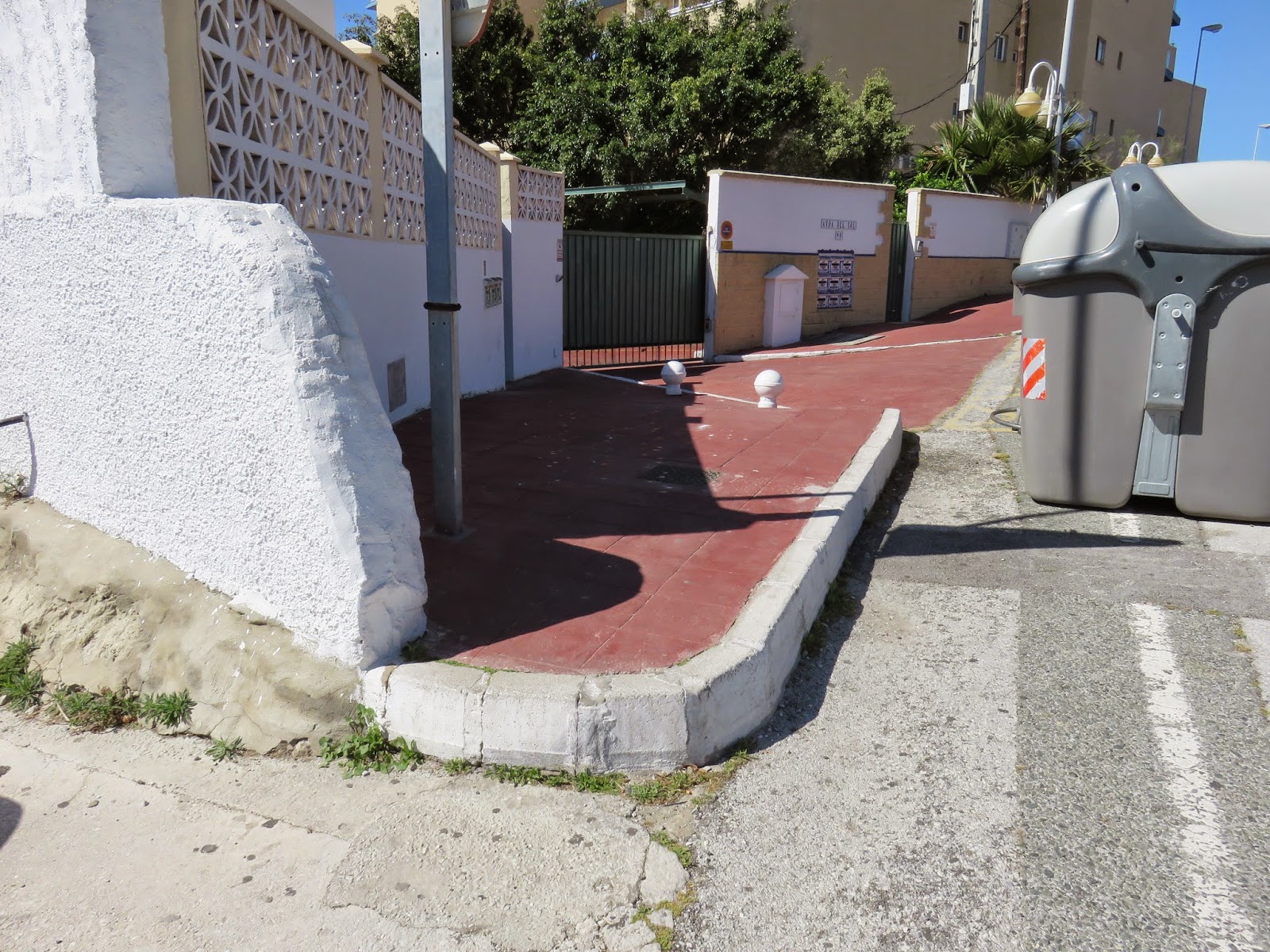
A steep drop from pavement to road: very difficult for independent wheelchair-users or pushers to control the chairs.


Missing ironworks - again a common feature - are just as potentially dangerous as raised ones.


Raised ironworks, potholes, cracks and uneven surface on a pedestrian-crossing.


Just as bad at the next junction with C/ Camelia.


And this dropped kerb does not actually align with the chewed-up crossing.


More obstacles


But you do get the sensory dropped kerb just before the crossing.


Nigh impossible to navigate round this item of street-furniture.


Missing ironworks: the pavement equivalent of a pothole!


Another low-hanging tree. The man ahead had to duck to pass under.


A rather steep, curving pavement.


Sensory and dropped kerb to traverse the zebra-crossing.


Keep going round if you are mobility impaired…


At the next crossing (the one we need)…


…we encounter a dropped kerb that has a lip.


The international symbol for disabled plus arrows attached to the front entrance point us to the right.


Alas, they're a tad difficult to perceive from the crossing, so one is going to make an unnecessary detour!


Access is via a side-door. I checked it opens really easily, despite looking sturdy.


There are three disabled-parking bays - but they are at the front, not at the side of the building!


Oftentimes, the buttons for requesting the green-man are set too high.


We now approach the area around the hotel Sunset Beach, where some of the worst examples of disablism on this route were encountered.

Above & below: avoid the steep, dropped kerbs and go round the bollards!


This hotel's one disabled-parking spot next to a ramp to an entrance.

Over the ironworks or brushed by the bush?


Another 'bus-stop inconveniently stationed in the centre of the pavement,

Oh, and a litter-bin!

Thou shalt not pass to the right…

…nor to the left!


Still, if one manages to negotiate the road and get back on to the pavement, there is a dropped kerb ahead.

A little steep - but that adds to the fun!

Can we get round this inconveniently located mini-bollard?

Yikes: why bother, even with a pusher this very high kerb would be extremely difficult to navigate!

And no way to pass close by as the waste authority has deposited a communal bin in the way.

The only way is to go into the road.

Hold on: there's a gap between the parked cars to the pavement…

But vehicles and bollards block any ability for pedestrians to continue, let alone wheelchair-users.

Oh, steps down to the disabled-ramp!

Back onto the road.


This looks like a steep drop.

But the smooth surface which becomes treacherously slippy when wet has been coated with non-slip strips.

Looking back, one can see just how steep the curving slope is.

Crossing with sensory & dropped kerbs.

However, on the other side you will not be able to pass between the post and the untrimmed shrubby without become very intimate with the bushes!


A 'bus-stop, built out from the pavement, so that the pavement remains clear for pedestrian traffic.


After a couple of months the upgrades at Carasco Beach are "complete".

The dropped kerb that is not: even the added-because-we-realise-we-miscalculated asphalt still leaves a lip up to the pavement.


Above & below double hand-rails for ambulant and wheelchair beach visitors.


This washed-out sign in pale blue on a white background advises that this is the bathing zone adapted for "invalids".

Dropped kerb next to disabled-parking bay.

Access for disabled folk.

Signage advising what facilities are available at the beach for those with impairments/disabilities.

The original ramp down to the beach, with no hand-rails.

A sign advising that we are on an adapted beach.

The beach facilities for folk with impairments/disabilities…

…which is LOCKED and there is no information as to how to obtain the key or access.

At least there is a disabled-wc.


The message from this image of a communal dustbin placed on a disabled-parking bay, is that we are unimportant?

The tourist point is accessible to the mobility impaired as there is level access from the western side. Wheelchair-users will just have to shout and hope someone hears you!

This crossing in the several months I have been here has been broken more than not when I have needed to use it. Wheelchair-users really would be taking their life in their hands if they attempted to traverse without assistance.

And on top of that, you also have to navigate the cracks and potholes.

This shop, one passes to reach the taxi-rank, has installed at least two ramps (see following two snaps).


And the final crossing to attain our goal of the taxi-rank next to the pharmacy, sensory pavements with dropped kerbs.


*


For more blog-posts for Blogging Against Disablism Day 2015 (#BADD2015) please check out the archive hosted by Diary of a Goldfish.