Showing posts with label Taxonomy. Show all posts

Wednesday, 12 May 2021

International M.E. Awareness Day 2021


Today, 12th May (US May 12th) is International M.E. Awareness Day. In some countries Myalgic Encephalomyelitis (M.E.) is misnamed Chronic Fatigue Syndrome (C.F.S.).


There are three categories of suffering per N.I.C.E.: mild - a loss of 50% of function (what other condition is described as “mild” with a loss of half one’s previous abilities!), but many can still work (G-d knows how!); moderate - mostly house-bound and unable to work; severe - mostly bed-bound. However, the M.E. community is well aware of a fourth category, “very severe”, in which sufferers are mostly blindfolded, earplugged & drip-fed, unable to do anything, not even move (often paralysed), but exist and suffer. Individuals quite literally die from M.E. [The image below is an M.E. taxonomy based on several international criteria - apologies to the sight-impaired, there is far too much text for me to type up.]
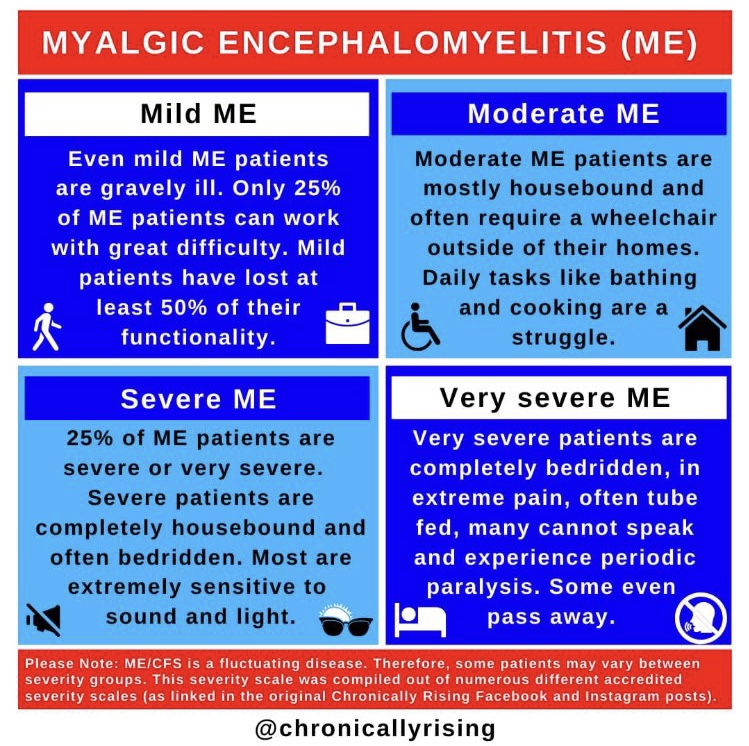


I was diagnosed with M.E in 1998. Prior to that I had been diagnosed as having Post-Viral Fatigue Syndrome. Both conditions are classified by the W.H.O. in ICD-10 at G93.3, as neurological conditions (and have been since 1969). Even so, in the U.K., Denmark & the Netherlands especially, where a psychiatric cabal control much of the medical establishment, and in the U.S. until relatively recently, the disease has been treated as a mental-health condition, in contradiction to all the scientific evidence which demonstrates inter alia differences in sufferers’ brains, spinal-columns, hearts, blood-flow, blood-work, biomes, etc.


Recently I have begun to suspect my condition probably commenced at puberty, if not beforehand. Under the current N.I.C.E. guidelines (which are about to be updated) I have been and am classified by my G.P. (family-doctor) and by my N.H.S. hospital-consultant as suffering the severe form. Mostly I am bed-bound, nigh on all the time house-bound. However, with one or two assistants, I am able to travel with lots of planning. This would put me in the moderate grouping. Similarly, there are times when I suffer temporary paralysis, which places me within the very severe grouping. M.E. Is an unpredictable disease that constantly fluctuates. Prior to Severe M.E. Day in August I hope to have conducted some research into my medical history, to attempt to determine the approximate start of my condition, assuming it is not congenital. As long as all goes well, I hope to publish a blog-post on 8th August (August 8th).
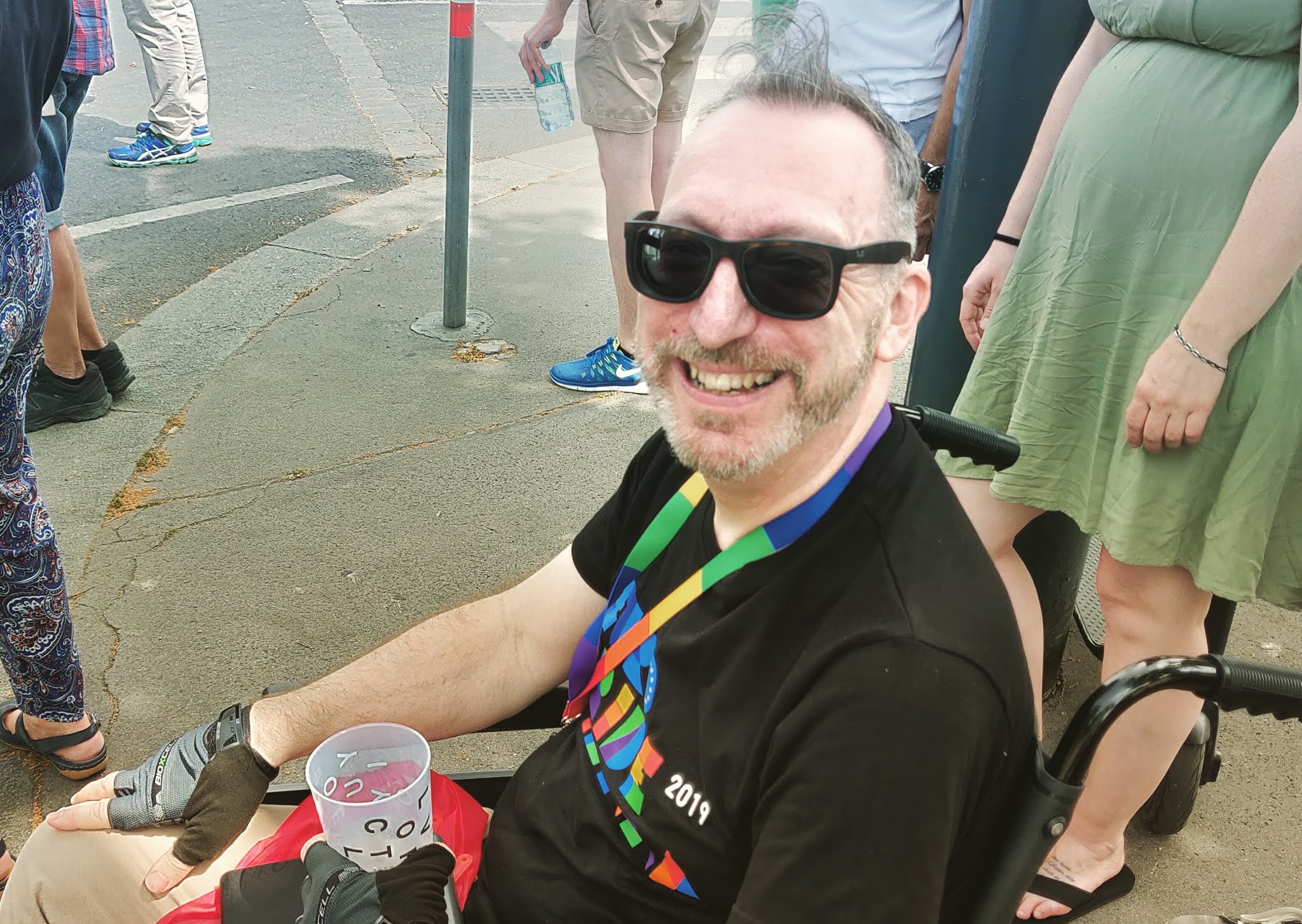


[Image Description: the writer in sunglasses and wheelchair enjoying a day out.]


However, for the purposes of my argument today, I am looking at the time-frame 1998-2021. Whilst the numbers of suffers of M.E. is in the tens of millions worldwide, and currently estimated - excluding the new-comers via Covid-19 so-called Long-Covid - to be circa 250,000 - 500,000 in the U.K. That is roughly 1:200 folk having some form of the disease. Every G.P.’s list is estimated to have around forty sufferers. And yet the vast majority of family-doctors know little or nothing about the disease apart from the myths and prejudices, which they (mostly) also perpetuate.


There is NO TREATMENT for M.E.  More than half-a-century has passed since the W.H.O. classified this disease. Until the 21st century very little medical-research was carried out. Even now, most research is funded by sufferers as governments have all but turned a blind-eye to both the disease and especially those who suffer from it. The Pharmaceutical industries have also done very little research (as far as is known), reluctant to invest monies when so little is known about the disease. However, in the past few years the Norwegian Prime Minister apologised to her citizens for their mistreatment by Norway’s health-services. Researchers, especially in the U.S., Australia, the Scandic countries and even the U.K. have been gradually uncovering the secrets of the illness and finding or developing treatments that may help sufferers. Whilst these are still the early-days for same, there is at least some hope.


*


If the reader knows a person with M.E. (PwME) within their family, friend-group, or community, please do consider volunteering some of your time &/or money to an M.E. Charity.


*


Apologies for the changes in text-size and alignment - this is not down to me, the writer, but due to issues with Blogger.


Thursday, 12 March 2015

¿Quién es quién? - an Illustrated Zoological Study of Gay Culture


[Image description: the original July 2013 edition on the left, the revised one on the right]

Last year I was delighted to review the Beartoncity tomes of the witty comic-artist Daniel Mainé. At the same time I also ordered a copy of another book which Daniel had illustrated, ¿Quién es quién?: Guía Illustrada Del Ambiente Para Gays Desubicados, authored by Enrique P. Sen. Unlike books published in the United Kingdom, Spanish publications do not state the font used. The one used in the book is rather small and, for someone with eyesight problems like myself, very difficult to read.  I could only read in bright daylight and little by little as it hurt to read.


[Image description: sample page showing text]

Thankfully Diabolo Ediciones commissioned a revised edition to take account of the recent changes in not just gay culture, but social mores across the spectrum. The revised edition, published in October 2014 is now hardback rather than softback and a new bolder font has been utilised. 

Such a shame then that twenty-three of my pages are blemished or marked (see the image below for a prime example. That represents some seventeen percent of the pages damaged. With a price-tag of just under eighteen Euros, one really would expect much better.

[Image description: blemished pages, including Daniel's artwork]

So to the contents. Enrique's observations are just so spot on. I was howling with laughter whilst reading the original edition at my favourite café-bar on the beach in Benalmádena. I have no doubt that many folk will recognise individuals they know who so fit the descriptions posited in Enrique's taxonomy.

There was definitely a need to add hipsters to the rogues' gallery. And my favourite of Daniel's illustrations is the 'estrellita', perhaps best translated by the term narcissist. The image of a hirsute bear floating in a plethora of approval and adoration is a marvel to behold - I love it!

Daniel's portraits of each stereotype adds to Enrique's text, more often than not contributing additional humour. Look, for example, for the study for the paranoid gay!

The revised edition is definitely an improvement on the original. With larger pages, the artworks can be seen to their full effect. If your bookshop still has the first edition in stock, unless you are a collector, skip it and insist on the second version.

%D

Friday, 18 May 2012

Pain: a Taxonomy


Here is an attempt at classification of the different types of pain from which I suffer. Obviously the degree of pain is variable, from dull to sharp to acute, and differs depending on the type of pain. For example: achy pain is never sharp or acute; piercing pain is never dull. I have listed the terms alphabetically, not in order of frequency or intensity.
This is not an attempt to elicit sympathy nor an extension of putative hypochondria, but a genuine attempt to come up with some pertinent descriptors.
You may be aware of other types of pain than the eighteen hereby listed. You may experience pain differently. So, please feel free to add comments below.
Achy - dull; relating to my fibromyalgia (FMS); or my osteoarthritis (OA), usually heralding damp weather.
Blinding - experienced as searing flashes of light; migraine &/or photophobia.
Cutting - Raynaud’s syndrome skin splits; feels like multiple paper-cuts.
Drilling - into temples; migraine; at its worst makes me bang my head on the wall.
Earachy - probably one of the most difficult pains to cope with as makes sleep impossible for me over a prolonged period.
Fiery - arthritis in joints: hips, lumber, shoulders, wrists, elbows, feet...
Headachy - front of skull (not migraine); this is the only pain for which my prescribed painkillers (codeine) actually work.
Itching - eczema; is insanely worse than a typical itch mixed with a high degree of soreness.
Nasal - a burning sensation accompanied by an über-taut muscular contraction (a sort of heightened awareness or prolonged about-to-sneeze feeling) in my nose in reaction to chemical- &/or odour-sensitivity.
Piercing - sharper than stabbing and moves through my body faster than travelling pain; front ribs thro’ to back ribs or v.v. (sometimes linked to costochondritis); similarly with feet; back of head thro’ to back of eyes.
Pressure - ranging from being touch-sensitive to bed-sores.
Prickly - eye-balls; sometimes a precursor to migraine or a reaction to photophobia.
Shooting - up and down limbs, faster than travelling pain and doesn’t move elsewhere.
Stabbing - in my back (sometimes linked to costochondritis); soles of feet; base of skull; irritable bowel syndrome (IBS); constipation; diarrhœa.
Throbbing - more intense than achy, but less acute than fiery; typically in my limbs &/or at the back of my skull-base and in my neck.
Toothachy - my dentist advises there is nothing wrong with my gnashers, it’s simply yet another effect of the myalgic encephalomyelitis (ME); it can be a random single tooth or a whole jaw of teeth.
Travelling - moving, seemingly at random, from one part of the body to another with no discernible pattern.
Vibrating - a whole of body reaction to my intolerance of vibration &/or sound; it’s a sort of edginess that echoes around my body in diminishing waves; I feel it particularly acutely in my ears.