Showing posts with label Research. Show all posts

Wednesday, 12 May 2021

International M.E. Awareness Day 2021


Today, 12th May (US May 12th) is International M.E. Awareness Day. In some countries Myalgic Encephalomyelitis (M.E.) is misnamed Chronic Fatigue Syndrome (C.F.S.).


There are three categories of suffering per N.I.C.E.: mild - a loss of 50% of function (what other condition is described as “mild” with a loss of half one’s previous abilities!), but many can still work (G-d knows how!); moderate - mostly house-bound and unable to work; severe - mostly bed-bound. However, the M.E. community is well aware of a fourth category, “very severe”, in which sufferers are mostly blindfolded, earplugged & drip-fed, unable to do anything, not even move (often paralysed), but exist and suffer. Individuals quite literally die from M.E. [The image below is an M.E. taxonomy based on several international criteria - apologies to the sight-impaired, there is far too much text for me to type up.]
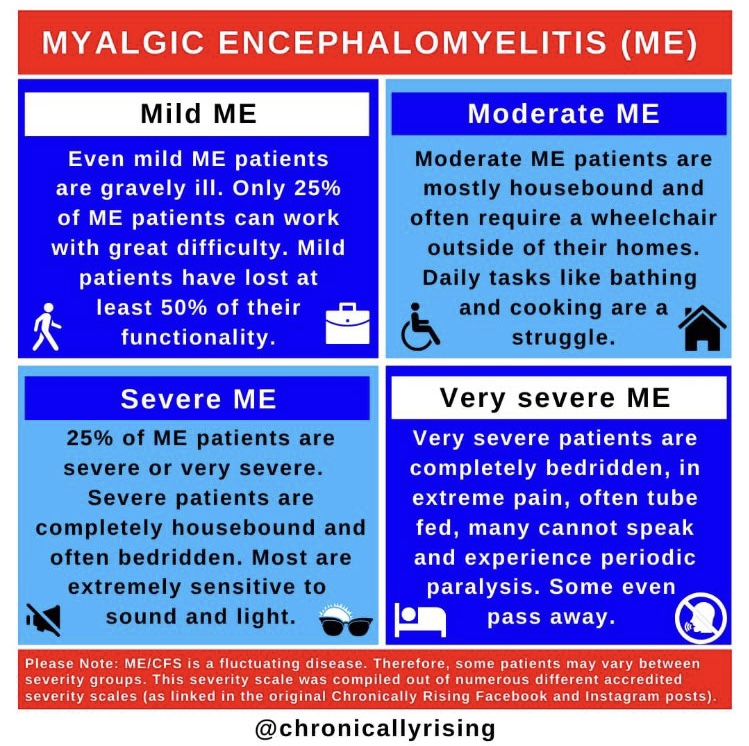


I was diagnosed with M.E in 1998. Prior to that I had been diagnosed as having Post-Viral Fatigue Syndrome. Both conditions are classified by the W.H.O. in ICD-10 at G93.3, as neurological conditions (and have been since 1969). Even so, in the U.K., Denmark & the Netherlands especially, where a psychiatric cabal control much of the medical establishment, and in the U.S. until relatively recently, the disease has been treated as a mental-health condition, in contradiction to all the scientific evidence which demonstrates inter alia differences in sufferers’ brains, spinal-columns, hearts, blood-flow, blood-work, biomes, etc.


Recently I have begun to suspect my condition probably commenced at puberty, if not beforehand. Under the current N.I.C.E. guidelines (which are about to be updated) I have been and am classified by my G.P. (family-doctor) and by my N.H.S. hospital-consultant as suffering the severe form. Mostly I am bed-bound, nigh on all the time house-bound. However, with one or two assistants, I am able to travel with lots of planning. This would put me in the moderate grouping. Similarly, there are times when I suffer temporary paralysis, which places me within the very severe grouping. M.E. Is an unpredictable disease that constantly fluctuates. Prior to Severe M.E. Day in August I hope to have conducted some research into my medical history, to attempt to determine the approximate start of my condition, assuming it is not congenital. As long as all goes well, I hope to publish a blog-post on 8th August (August 8th).
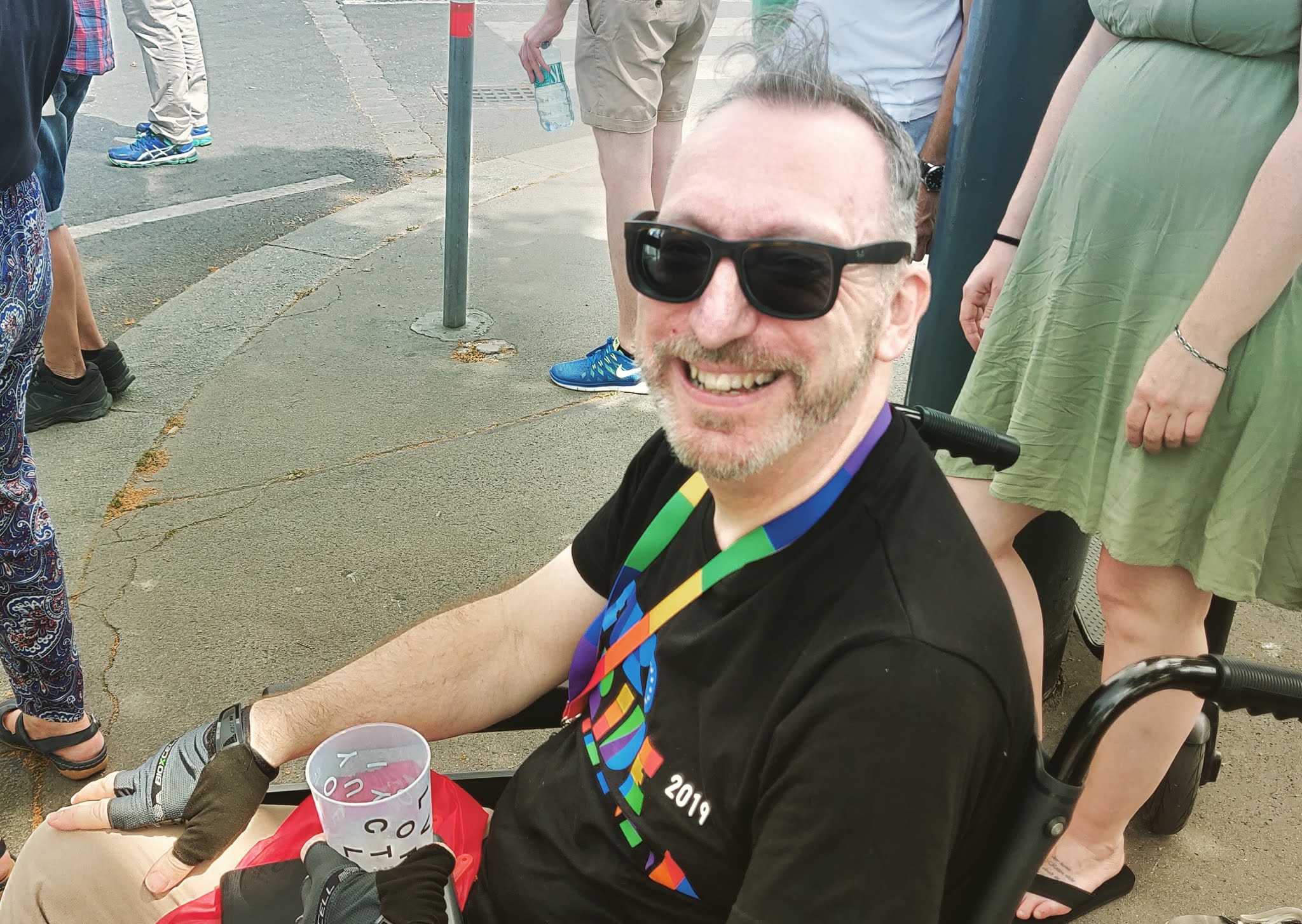


[Image Description: the writer in sunglasses and wheelchair enjoying a day out.]


However, for the purposes of my argument today, I am looking at the time-frame 1998-2021. Whilst the numbers of suffers of M.E. is in the tens of millions worldwide, and currently estimated - excluding the new-comers via Covid-19 so-called Long-Covid - to be circa 250,000 - 500,000 in the U.K. That is roughly 1:200 folk having some form of the disease. Every G.P.’s list is estimated to have around forty sufferers. And yet the vast majority of family-doctors know little or nothing about the disease apart from the myths and prejudices, which they (mostly) also perpetuate.


There is NO TREATMENT for M.E.  More than half-a-century has passed since the W.H.O. classified this disease. Until the 21st century very little medical-research was carried out. Even now, most research is funded by sufferers as governments have all but turned a blind-eye to both the disease and especially those who suffer from it. The Pharmaceutical industries have also done very little research (as far as is known), reluctant to invest monies when so little is known about the disease. However, in the past few years the Norwegian Prime Minister apologised to her citizens for their mistreatment by Norway’s health-services. Researchers, especially in the U.S., Australia, the Scandic countries and even the U.K. have been gradually uncovering the secrets of the illness and finding or developing treatments that may help sufferers. Whilst these are still the early-days for same, there is at least some hope.


*


If the reader knows a person with M.E. (PwME) within their family, friend-group, or community, please do consider volunteering some of your time &/or money to an M.E. Charity.


*


Apologies for the changes in text-size and alignment - this is not down to me, the writer, but due to issues with Blogger.


Tuesday, 12 May 2020

International M.E. Awareness Day 2020


I have not been well enough at this time of the year since 2017, so this is my first blog-post to mark the international Myalgic Encephalomyelitis awareness day in three years. (Underneath this blog-post is a list of words and terms, click on any of the ones referring to M.E. to find some of my previous outpourings.)

Under the UK’s current N.I.C.E. Guidelines and by my NHS hospital specialist, I am classified as having the severe form of M.E. There are three official categories: mild, moderate, & severe. However, the severe category itself covers a range of folk from those who are mostly bed-bound, like myself, to those who cannot ingest food or water and have to be kept alive via feeds.

In my previous blog-post I wrote:

“M.E. is not about being tired all the time. It is not a psychiatric illness as the UK’s psycho-cabal (along with their colleagues in Holland & Denmark) would have us believe. It is a multi-systemic, neurological disease (recognised for decades as such by the WHO, currently under ICD-10 G93.3). There are 106 conditions on my health spreadsheet; 104 are connected with Myalgic Encephalomyelitis. Only three are related to sleep. Under the WHO’s ICD-10 I have conditions under sections I, IV, V, VI, VII, VIII, IX, X, XI, XII, XIII, XVIII & XIX.”

I have mulled over the possible threat to my privacy and so forth, but have decided to publish the full list of my conditions. Obviously I have had to hide certain personal details to prevent identity-theft. I am not publishing this list to garner sympathy. My hope is that the reader will come to realise just how ghastly this disease is in its depth and breadth of conditions and symptoms. Many of these are covered in the broad and all-enveloping rubric of the term Myalgic Encephalomyelitis, many are classed as co-morbidities; but which is which is very much still debated.

The list below has not been updated since 2016. However, since that time my medications have altered. I have left the original medicines listed so one has a sense of what is or, in most instances, is not available.

The European Parliament recently unanimously voted for more funding for research into the biological causes of M.E., because despite millions suffering across Europe (and indeed the World), very little is invested into medical research. Individuals with the worst form of M.E. have worse quality of life scores than any other measured illness, including cancers and AIDs. Because we are hidden in our homes, we are ignored or dismissed. Please consider donating time or money to a Myalgic Encephalomyelitis charity or research proposal.


Monday, 12 October 2015

Non-Governmental ESA & WCA Research

Ekklesia are researching how Employment & Support Allowance (ESA)‬ & the notorious and much-hated ‪Work Capability Assessment (‎WCA)‬ might be reformed or replaced. To this end they have devised an online questionnaire. Most of the questions are multi-choice with optional boxes.

I only wrote one long answer in respect to how any future benefit ought to look. My answer for Q. 30:

"I think it should be far more tiered, with the more points you get the higher the benefit awarded in order to account for extra costs - or if not tiered then with the addition of non-refundable grants. For example, someone with impaired mobility should be given an award towards a wheelchair and with each additional impairment an extra grant; someone who is sight-impaired should be given a grant to cover the costs of technology. At the top would be quadriplegics awarded grants to cover all necessary equipment.

Alternatively, the State should have a centralised purchasing body in order to save money through mass purchasing. Or a mixture of the two, so if someone wishes to pay more for equipment or does not want the State-offered product, they are free to choose.

Those requiring care, ought to receive additional components to cover such costs or the State ought to be obliged to pay for necessary care as in Sweden, for example. The additional benefit to society is the creation of employment opportunities and thus more folk boosting the economy.

There may also need to be a way for folk to receive grants or extra benefit to access private health-care which the NHS will not/cannot provide. E.g. I need physiotherapy, which I have to pay myself, as due to very variable conditions I cannot keep appointments, thus the NHS refuse to provide. Similarly, I cannot access mental-health support, etc."

If you have been through the WCA-process, please do help out with this research. One is given plenty of opportunities to save and go back at a later time, if one so wishes.

[Image description: Ekklesia logo ©]

Sunday, 31 May 2015

Global Endemic Plague

Imagine if the total populations of:

Vatican City
Gibraltar
San Marino
Monaco
Liechtenstein
Faroe Islands
Guernsey
Andorra
Isle of Man
Jersey
Northern Cyprus
Iceland
Malta
Luxembourg
Montenegro
Cyprus
Estonia
Kosovo
Latvia
Slovenia
Macedonia
Albania
Lithuania
Moldova
&
Greater Manchester (England)

were struck down with an illness and could not work. What a terrible effect this would have on their communities and economies! These are the kinds of figures we are dealing with on a global scale of the numbers of individuals struck down with my infirmity. For those afflicted, their families, loved ones and communities have to care for them. Worse still: the ill probably do not receive, unless very fortunate, appropriate medical care let alone nursing support. The medical establishment in most countries all but ignores the illness and next to no research is executed into finding the cause/es let alone possible treatments.

The illness is more common in the United Kingdom than Parkinsons, Multiple Sclerosis, Cystic Fibrosis, Motor Neurone Disease, and equal to 75% of those affected by all cancers.

Imagine if your government banned you from donating blood or organs, even after death, but then colluded with the medical establishment to dismiss sufferers as only needing cognitive behavioural therapy (C.B.T.) and/or exercise to get better, despite the evidence demonstrating that these do not work.

This illness is Myalgic Encephalomyelitis or M.E. We need help and support now!

Every year the month of May is designated #MEAwarenessMonth and 12th May is #InternationalMEAwarenessDay to co-incide with the birthday of Florence Nightingale, one of the most famous sufferers.

Please consider googling "UK ME charities" and making a donation or even offering your time and service by volunteering.

And yes, whilst I have some good periods, most of my life for the past several years has been abed. The following description very much describes my quotidian experience of the disease. (Apologies to the visually impaired for not transcribing - it's very long!) 


[Image courtesy & © MEAwarenessPics]


Tuesday, 6 November 2012

Lack of Updates

Many apologies to my two followers and all my readers for the lack of blogging. Really under the weather with my conditions at the moment. As soon as I have more energy I shall get back to researching and writing. %)